


Read & explore together
Admiration by the Bridegroom
Song of Solomon 7:1-13 is a love poem in which the beloved is praised with rich comparisons drawn from beauty, fruitfulness and delight. The passage stays in the language of poetry, speaking through images rather than plain description.
Understanding the passage
Read these words in context
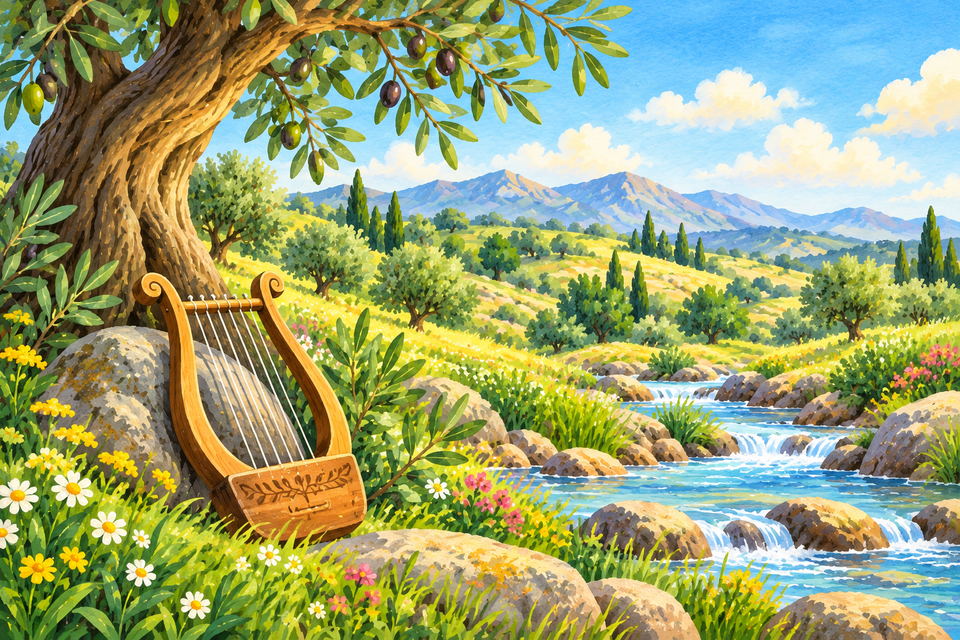
In this passage, one voice admires the beloved from feet to head and calls her beautiful and pleasant. The poem then turns to mutual love: the beloved says she belongs to her beloved and that his desire is toward her, and she invites him to go out among fields and vineyards. The text is given as poetry and song, so its comparisons should be read as poetic praise.
Song of Solomon 7:1–13Main takeaway
This poem presents mutual delight and affectionate admiration through poetic images of beauty, fruitfulness and belonging.
Explore the poem and its images
Open a card to explore the full explanation and its Bible references.
01A body praised through poetic imagesThe speaker begins with admiration from the feet upward, using comparisons to jewels, a goblet, wheat, lilies and fawns.
Explanation
The speaker begins with admiration from the feet upward, using comparisons to jewels, a goblet, wheat, lilies and fawns. These are poetic images, not literal descriptions. The repeated word “like” shows that the poem expresses beauty through comparison and crafted language.
02Beauty described from neck to hairThe poem continues upward, comparing neck, eyes, nose, head and hair to towers, pools, Carmel and purple.
Explanation
The poem continues upward, comparing neck, eyes, nose, head and hair to towers, pools, Carmel and purple. These images suggest splendour and striking presence. The line about the king being “held captive” in her hair uses vivid poetic language to show strong attraction.
03Delight and desire in the belovedThe speaker openly calls the beloved beautiful and pleasant, then uses the image of a palm tree and fruit to speak of desire.
Explanation
The speaker openly calls the beloved beautiful and pleasant, then uses the image of a palm tree and fruit to speak of desire. The comparisons to clusters of the vine, apples and wine continue the poem’s language of sweetness, enjoyment and delight.
04Mutual belonging and shared loveThe beloved answers, “I am my beloved’s. His desire is toward me.” She then invites him into the field, villages and vineyards.
Explanation
The beloved answers, “I am my beloved’s. His desire is toward me.” She then invites him into the field, villages and vineyards. Fruit, blossoms, fragrance and precious fruits all deepen the poem’s picture of shared love, welcome and readiness to give affection.
Questions to explore
Pause, look back at the verses and talk together.
01What words or images show that this passage is poetry rather than plain description?
Look for repeated comparisons such as “like jewels”, “like a round goblet”, “like the pools”, and “like the best wine”.
02How does the poem show that love here is mutual, not one-sided?
Notice both the speaker’s praise and the beloved’s own words, especially “I am my beloved’s” and her invitation to go together.
03What effect do the vineyard, blossoms, fragrance and fruits have on the meaning of the poem?
These images connect love with abundance, sweetness and enjoyment within the poem’s own language.
Read the Bible passage
World English Bible ClassicScripture quotation · Public domain
Song of Solomon 7:1–13
1How beautiful are your feet in sandals, prince’s daughter! Your rounded thighs are like jewels, the work of the hands of a skillful workman.
2Your body is like a round goblet, no mixed wine is wanting. Your waist is like a heap of wheat, set about with lilies.
3Your two breasts are like two fawns, that are twins of a roe.
4Your neck is like an ivory tower. Your eyes are like the pools in Heshbon by the gate of Bathrabbim. Your nose is like the tower of Lebanon which looks toward Damascus.
5Your head on you is like Carmel. The hair of your head like purple. The king is held captive in its tresses.
6How beautiful and how pleasant you are, love, for delights!
7This, your stature, is like a palm tree, your breasts like its fruit.
8I said, “I will climb up into the palm tree. I will take hold of its fruit.” Let your breasts be like clusters of the vine, the smell of your breath like apples.
9Your mouth is like the best wine, that goes down smoothly for my beloved, gliding through the lips of those who are asleep. Beloved
10I am my beloved’s. His desire is toward me.
11Come, my beloved! Let’s go out into the field. Let’s lodge in the villages.
12Let’s go early up to the vineyards. Let’s see whether the vine has budded, its blossom is open, and the pomegranates are in flower. There I will give you my love.
13The mandrakes produce fragrance. At our doors are all kinds of precious fruits, new and old, which I have stored up for you, my beloved.