


Read & explore together
Israel’s Kingdom Blessing
Psalm 108 begins with determined praise and moves into a prayer for help. The singer speaks confidently about God’s greatness, repeats God’s own words about lands and peoples, and then asks God to help where human strength cannot.
Understanding the passage
Read these words in context
This passage is a psalm, so it uses the language of song and prayer. It opens with thanksgiving and praise to God, then asks for deliverance. In the middle, God’s words about places and nations are quoted, and the psalm ends with a request for help against enemies.
Psalms 108:1–13Main takeaway
Psalm 108 teaches that God’s people respond to need with praise, prayer, and trust in God rather than human help.
Explore the poem and its images
Open a card to explore the full explanation and its Bible references.
01A steadfast heart singsThe psalm starts with resolve. The singer’s heart is “steadfast”, meaning fixed and firm toward God.
Explanation
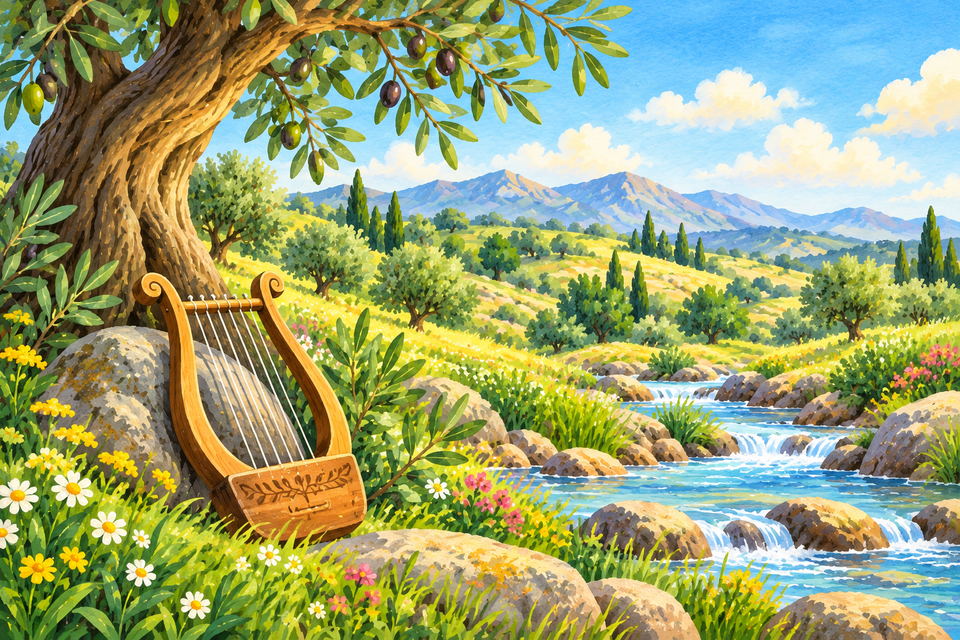
The psalm starts with resolve. The singer’s heart is “steadfast”, meaning fixed and firm toward God. Because of that, he chooses to sing and make music. Even the harp and lyre are called to wake up, showing eagerness to praise God from the beginning of the day.
02Praise reaches beyond one placeThe singer promises to thank Yahweh “among the nations” and praise him “among the peoples”.
Explanation
The singer promises to thank Yahweh “among the nations” and praise him “among the peoples”. The reason is God’s character: his loving kindness is great above the heavens, and his faithfulness reaches to the skies. Then comes a prayer that God would be exalted and his glory be over all the earth.
03God speaks of what belongs to himThe psalm asks God to save “your beloved” with his right hand and answer them. Then God’s speech is quoted from his sanctuary.
Explanation
The psalm asks God to save “your beloved” with his right hand and answer them. Then God’s speech is quoted from his sanctuary. He names Shechem, Succoth, Gilead, Manasseh, Ephraim, and Judah as his. He also speaks over Moab, Edom, and Philistia, showing his authority in the poem’s own words.
04Help must come from GodThe final part asks who will bring the singer into the fortified city and lead him to Edom.
Explanation
The final part asks who will bring the singer into the fortified city and lead him to Edom. It then asks whether God has rejected “us” and says God does not go out with their armies. The prayer stays direct: “Give us help against the enemy”, because “the help of man is vain”, and “Through God, we will do valiantly.”
Questions to explore
Pause, look back at the verses and talk together.
01What does the psalmist choose to do because his heart is steadfast?
Look for the action words at the start of the psalm: he says he will sing, make music, and wake the dawn with praise.
02Why does the singer praise God among the nations and peoples?
The psalm gives two reasons in God’s character: his loving kindness and his faithfulness are described with sky-high language.
03What contrast appears in the last two verses about help?
Notice that help from people is called vain, while strength for action is spoken of as coming through God.
Read the Bible passage
World English Bible ClassicScripture quotation · Public domain
Psalms 108:1–13
1My heart is steadfast, God. I will sing and I will make music with my soul.
2Wake up, harp and lyre! I will wake up the dawn.
3I will give thanks to you, Yahweh, among the nations. I will sing praises to you among the peoples.
4For your loving kindness is great above the heavens. Your faithfulness reaches to the skies.
5Be exalted, God, above the heavens! Let your glory be over all the earth.
6That your beloved may be delivered, save with your right hand, and answer us.
7God has spoken from his sanctuary: “In triumph, I will divide Shechem, and measure out the valley of Succoth.
8Gilead is mine. Manasseh is mine. Ephraim also is my helmet. Judah is my scepter.
9Moab is my wash pot. I will toss my sandal on Edom. I will shout over Philistia.”
10Who will bring me into the fortified city? Who will lead me to Edom?
11Haven’t you rejected us, God? You don’t go out, God, with our armies.
12Give us help against the enemy, for the help of man is vain.
13Through God, we will do valiantly, for it is he who will tread down our enemies.