


Read & explore together
Solomon Admires His Bride
This song speaks with rich pictures of beauty, fragrance and desire. It should be read as poetry, not expanded into extra story events. The passage moves from praise, to invitation, to a shared garden image.
Understanding the passage
Read these words in context
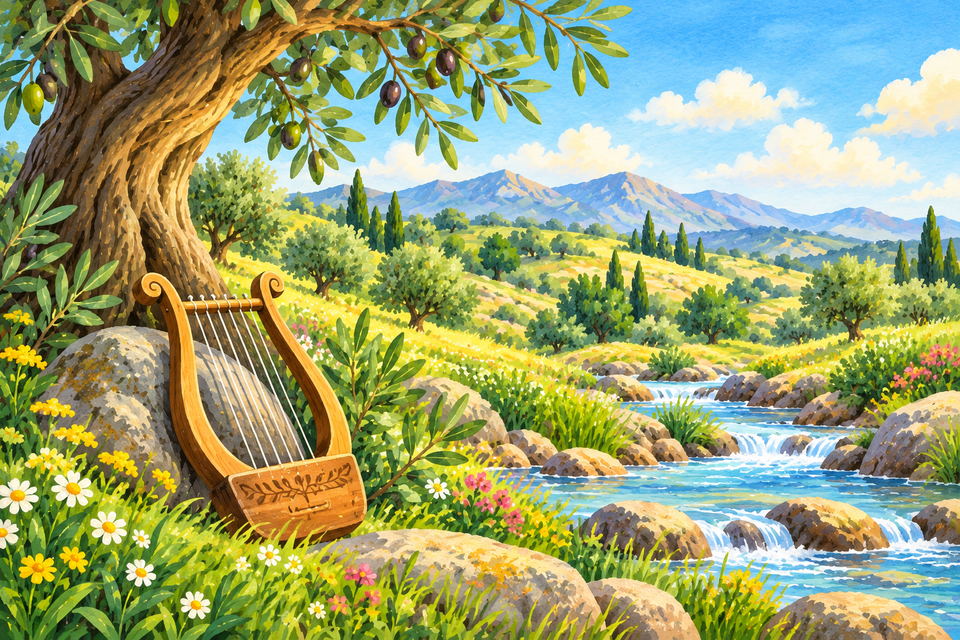
In Song of Solomon 4:1–16, the beloved addresses “my love” and “my bride” with comparisons drawn from animals, fruit, perfume, mountains and water. The poem ends with the bride’s own invitation, continuing the same symbolic language of a garden and its spices.
Song of Solomon 4:1–16Main takeaway
This passage uses poetic images to express honour, delight and mutual invitation in love.
Explore the poem and its images
Open a card to explore the full explanation and its Bible references.
01Praise in vivid comparisonsThe opening repeats, “you are beautiful”, then describes features with images rather than plain detail.
Explanation
The opening repeats, “you are beautiful”, then describes features with images rather than plain detail. Eyes are like doves, lips like scarlet thread, temples like pomegranate, and the neck like a tower. This is the language of song, showing admiration through memorable pictures.
02Whole beauty and fragrant hillsAfter the earlier comparisons, the beloved says, “You are all beautiful, my love. There is no spot in you.”
Explanation
After the earlier comparisons, the beloved says, “You are all beautiful, my love. There is no spot in you.” Just before that, he speaks of going to “the mountain of myrrh” and “the hill of frankincense”, using perfume imagery. The praise is complete and strongly expressive.
03Bride, love and sweetnessThe address “my sister, my bride” is repeated as a title of closeness within the poem. Her love is better than wine, her perfumes than spices, and her lips and tongue are pictured with honey and milk.
Explanation
The address “my sister, my bride” is repeated as a title of closeness within the poem. Her love is better than wine, her perfumes than spices, and her lips and tongue are pictured with honey and milk. The language keeps stressing sweetness, fragrance and delight.
04A garden invited openThe bride is compared to a locked garden, a sealed fountain, and then to an orchard full of precious fruits and spices, with living waters flowing.
Explanation
The bride is compared to a locked garden, a sealed fountain, and then to an orchard full of precious fruits and spices, with living waters flowing. In the final verse, the winds are called to blow on the garden so its spices may flow out, and the beloved is invited to come.
Questions to explore
Pause, look back at the verses and talk together.
01What repeated kinds of images does the poem use to show beauty and delight?
Look for pictures from birds, animals, fruit, perfume, water and buildings, and notice how they shape the praise.
02How does verse 7 change the flow of the poem?
Notice that after many individual comparisons, the beloved gives a whole summary: “You are all beautiful”.
03What movement happens in the garden imagery at the end?
The poem moves from “locked up” and “sealed” language to spices flowing out and an invitation to come in.
Read the Bible passage
World English Bible ClassicScripture quotation · Public domain
Song of Solomon 4:1–16
1Behold, you are beautiful, my love. Behold, you are beautiful. Your eyes are like doves behind your veil. Your hair is as a flock of goats, that descend from Mount Gilead.
2Your teeth are like a newly shorn flock, which have come up from the washing, where every one of them has twins. None is bereaved among them.
3Your lips are like scarlet thread. Your mouth is lovely. Your temples are like a piece of a pomegranate behind your veil.
4Your neck is like David’s tower built for an armory, on which a thousand shields hang, all the shields of the mighty men.
5Your two breasts are like two fawns that are twins of a roe, which feed among the lilies.
6Until the day is cool, and the shadows flee away, I will go to the mountain of myrrh, to the hill of frankincense.
7You are all beautiful, my love. There is no spot in you.
8Come with me from Lebanon, my bride, with me from Lebanon. Look from the top of Amana, from the top of Senir and Hermon, from the lions’ dens, from the mountains of the leopards.
9You have ravished my heart, my sister, my bride. You have ravished my heart with one of your eyes, with one chain of your neck.
10How beautiful is your love, my sister, my bride! How much better is your love than wine, the fragrance of your perfumes than all kinds of spices!
11Your lips, my bride, drip like the honeycomb. Honey and milk are under your tongue. The smell of your garments is like the smell of Lebanon.
12My sister, my bride, is a locked up garden; a locked up spring, a sealed fountain.
13Your shoots are an orchard of pomegranates, with precious fruits, henna with spikenard plants,
14spikenard and saffron, calamus and cinnamon, with every kind of incense tree; myrrh and aloes, with all the best spices,
15a fountain of gardens, a well of living waters, flowing streams from Lebanon. Beloved
16Awake, north wind, and come, you south! Blow on my garden, that its spices may flow out. Let my beloved come into his garden, and taste his precious fruits.