


Read & explore together
The Ten Commandments
These commandments begin with Yahweh’s own words and his rescue from Egypt. Exodus 20 and Deuteronomy 5 present the same commands, and reading both formulations carefully shows repeated truths and some meaningful wording differences.
Understanding the passage
Before the commandments, a rescue
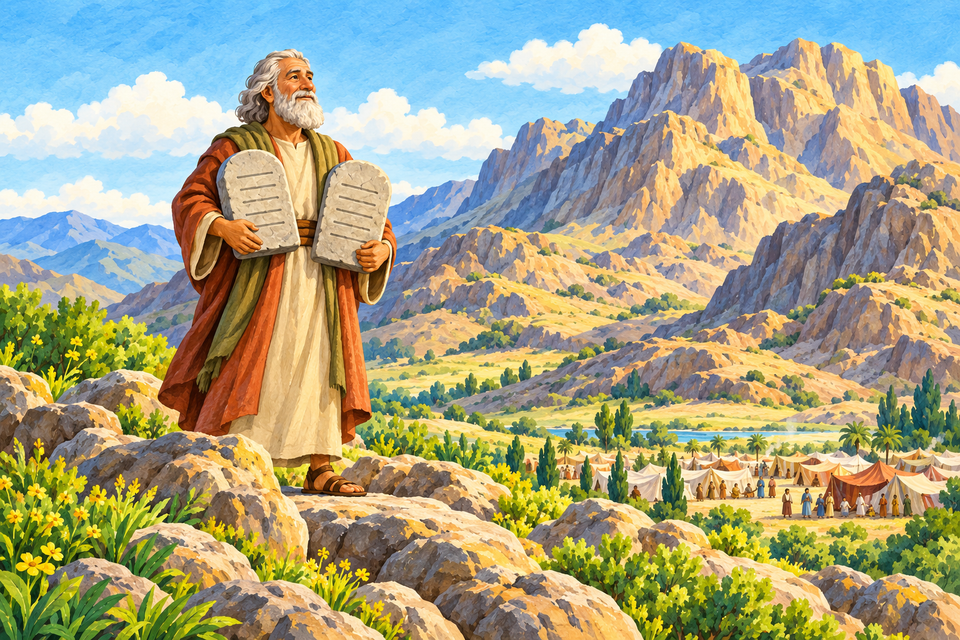
Exodus opens by saying that God spoke these words and first declared, “I am Yahweh your God,” who brought the people out of Egypt, out of bondage. Deuteronomy says Moses stood between Yahweh and the people to show them Yahweh’s word, and then repeats the same opening declaration of rescue.
Exodus 20:1–17; Deuteronomy 5:5–21Main takeaway
The Ten Commandments call for exclusive worship of Yahweh, careful honour for his name and day, honour for parents, truthfulness and neighbour-love that rejects murder, adultery, stealing, false witness and coveting.
Explore the ten commandments
These are explanations and summaries. Read the full Scripture wording below.
Commandment numbering differs between Christian traditions.01Worship God aloneGive your loyalty to God.
Explanation
The command calls Israel to undivided loyalty to Yahweh, the God who has rescued them.
02Do not worship idolsDo not make and serve an idol.
Explanation
The command forbids making an idol or image to bow down to or serve. Read the fuller wording in both passages.
Scripture · Exodus 20:4–6
4 “You shall not make for yourselves an idol, nor any image of anything that is in the heavens above, or that is on the earth beneath, or that is in the water under the earth:
5 you shall not bow yourself down to them, nor serve them, for I, Yahweh your God, am a jealous God, visiting the iniquity of the fathers on the children, on the third and on the fourth generation of those who hate me,
6 and showing loving kindness to thousands of those who love me and keep my commandments.
Scripture · Deuteronomy 5:8–10
8 “You shall not make a carved image for yourself—any likeness of what is in heaven above, or what is on the earth beneath, or that is in the water under the earth.
9 You shall not bow yourself down to them, nor serve them, for I, Yahweh your God, am a jealous God, visiting the iniquity of the fathers on the children and on the third and on the fourth generation of those who hate me
10 and showing loving kindness to thousands of those who love me and keep my commandments.
03Honour God’s nameDo not misuse his name.
Explanation
Both passages forbid misusing Yahweh’s name and take that misuse seriously.
Scripture · Exodus 20:7
7 “You shall not misuse the name of Yahweh your God, for Yahweh will not hold him guiltless who misuses his name.
Scripture · Deuteronomy 5:11
11 “You shall not misuse the name of Yahweh your God; for Yahweh will not hold him guiltless who misuses his name.
04Keep the Sabbath holySet apart the day for rest.
Explanation
Compare the instruction to remember in Exodus with the instruction to observe in Deuteronomy, and notice the reason each gives.
Scripture · Exodus 20:8–11
8 “Remember the Sabbath day, to keep it holy.
9 You shall labor six days, and do all your work,
10 but the seventh day is a Sabbath to Yahweh your God. You shall not do any work in it, you, nor your son, nor your daughter, your male servant, nor your female servant, nor your livestock, nor your stranger who is within your gates;
11 for in six days Yahweh made heaven and earth, the sea, and all that is in them, and rested the seventh day; therefore Yahweh blessed the Sabbath day, and made it holy.
Scripture · Deuteronomy 5:12–15
12 “Observe the Sabbath day, to keep it holy, as Yahweh your God commanded you.
13 You shall labor six days, and do all your work;
14 but the seventh day is a Sabbath to Yahweh your God, in which you shall not do any work—neither you, nor your son, nor your daughter, nor your male servant, nor your female servant, nor your ox, nor your donkey, nor any of your livestock, nor your stranger who is within your gates; that your male servant and your female servant may rest as well as you.
15 You shall remember that you were a servant in the land of Egypt, and Yahweh your God brought you out of there by a mighty hand and by an outstretched arm. Therefore Yahweh your God commanded you to keep the Sabbath day.
05Honour your parentsHonour your father and mother.
Explanation
Both passages call for honouring father and mother. Deuteronomy adds wording about it going well with the people.
Scripture · Exodus 20:12
12 “Honor your father and your mother, that your days may be long in the land which Yahweh your God gives you.
Scripture · Deuteronomy 5:16
16 “Honor your father and your mother, as Yahweh your God commanded you, that your days may be long and that it may go well with you in the land which Yahweh your God gives you.
06Do not murderRespect human life.
Explanation
The same brief prohibition appears in both passages. Read its place among the commands concerning other people.
07Do not commit adulteryBe faithful in marriage.
Explanation
Both passages prohibit adultery. Keep the command’s actual wording distinct from this short explanation.
08Do not stealRespect what belongs to others.
Explanation
Both passages prohibit stealing as part of the commands about life with other people.
09Do not give false testimonySpeak truthfully about others.
Explanation
The command concerns false testimony against a neighbour. Both readings connect truthfulness with how a neighbour is treated.
Scripture · Deuteronomy 5:20
20 “You shall not give false testimony against your neighbor.
10Do not covetDo not desire what belongs to your neighbour.
Explanation
Compare the order of house and wife in the final command, and notice that Deuteronomy also names the field.
Scripture · Exodus 20:17
17 “You shall not covet your neighbor’s house. You shall not covet your neighbor’s wife, nor his male servant, nor his female servant, nor his ox, nor his donkey, nor anything that is your neighbor’s.”
Scripture · Deuteronomy 5:21
21 “You shall not covet your neighbor’s wife. Neither shall you desire your neighbor’s house, his field, or his male servant, or his female servant, his ox, or his donkey, or anything that is your neighbor’s.”
Explore the full passage guideOpening words, each formulation and the complete explanations
01Opening words: Yahweh speaks and rescuesThe commandments start with God’s speech, not a human opinion. In both books, Yahweh first names himself as the God who brought his people out of Egypt, out of bondage.
Explanation
The commandments start with God’s speech, not a human opinion. In both books, Yahweh first names himself as the God who brought his people out of Egypt, out of bondage. Deuteronomy also notes that Moses stood between Yahweh and the people to show them Yahweh’s word because they were afraid.
02Exodus formulation: commands 1 to 4In Exodus, the first commands require undivided loyalty to Yahweh. No other gods are to be before him, and no idol or image is to be made, bowed to, or served.
Explanation
In Exodus, the first commands require undivided loyalty to Yahweh. No other gods are to be before him, and no idol or image is to be made, bowed to, or served. His name must not be misused. The Sabbath is to be remembered and kept holy, with six workdays and a seventh day of rest because Yahweh made heaven and earth in six days and rested on the seventh.
03Deuteronomy formulation: commands 1 to 4Deuteronomy gives the same opening commands with closely related wording. Again, no other gods or carved images are permitted, and Yahweh’s name must not be misused.
Explanation
Deuteronomy gives the same opening commands with closely related wording. Again, no other gods or carved images are permitted, and Yahweh’s name must not be misused. For the Sabbath, Deuteronomy says “Observe” the day and keep it holy. It also stresses that servants, strangers and livestock are to rest, and it gives Israel’s rescue from Egypt as the reason for keeping the day.
04Exodus formulation: commands 5 to 10Exodus then turns to commands about life with other people. Father and mother are to be honoured, with long days in the land.
Explanation
Exodus then turns to commands about life with other people. Father and mother are to be honoured, with long days in the land. Murder, adultery, stealing and false testimony are forbidden. The final command forbids coveting a neighbour’s house, wife, servants, animals, or anything that belongs to that neighbour.
05Deuteronomy formulation: commands 5 to 10Deuteronomy repeats these commands in the same order, with some fuller wording. Honouring father and mother includes “as Yahweh your God commanded you” and adds “that it may go well with you”.
Explanation
Deuteronomy repeats these commands in the same order, with some fuller wording. Honouring father and mother includes “as Yahweh your God commanded you” and adds “that it may go well with you”. In the final command, the neighbour’s wife is named first, then house, field, servants, animals and anything else. The extra mention of “field” is part of Deuteronomy’s wording.
Two passages. What changes?
The same commands, with details worth noticing.
Scroll across to compare the readings.
| Look closely | Exodus 20 | Deuteronomy 5 |
|---|---|---|
| Opening words | God identifies himself as the one who brought Israel out of bondage. | The same rescue declaration follows the note about Moses standing between Yahweh and the people. |
| Sabbath | Remember the day; the reason points to creation and Yahweh’s rest. | Observe the day; the reason points to rescue from slavery, with rest for servants as well. |
| Honouring parents | A promise of long days in the land. | Also adds that it may go well with you. |
| Coveting | The house is listed before the wife. | The wife is listed first; the field is also named. |
Questions to explore
Pause, look back at the verses and talk together.
01What does Yahweh say about himself before any command is given?
Look for the repeated statement that names Yahweh and recalls bringing the people out of Egypt, out of bondage.
02What difference do you notice between “Remember the Sabbath day” and “Observe the Sabbath day”?
Read the Sabbath wording in each book and then compare the reasons given around it, including creation in Exodus and rescue from Egypt in Deuteronomy.
03How is the final command worded differently in Exodus and Deuteronomy?
Compare the order of “house” and “wife”, and notice that Deuteronomy also includes the neighbour’s “field”.
Read the Bible passages
World English Bible ClassicScripture quotation · Public domain
Exodus 20:1–17
1God spoke all these words, saying,
2“I am Yahweh your God, who brought you out of the land of Egypt, out of the house of bondage.
3“You shall have no other gods before me.
4“You shall not make for yourselves an idol, nor any image of anything that is in the heavens above, or that is on the earth beneath, or that is in the water under the earth:
5you shall not bow yourself down to them, nor serve them, for I, Yahweh your God, am a jealous God, visiting the iniquity of the fathers on the children, on the third and on the fourth generation of those who hate me,
6and showing loving kindness to thousands of those who love me and keep my commandments.
7“You shall not misuse the name of Yahweh your God, for Yahweh will not hold him guiltless who misuses his name.
8“Remember the Sabbath day, to keep it holy.
9You shall labor six days, and do all your work,
10but the seventh day is a Sabbath to Yahweh your God. You shall not do any work in it, you, nor your son, nor your daughter, your male servant, nor your female servant, nor your livestock, nor your stranger who is within your gates;
11for in six days Yahweh made heaven and earth, the sea, and all that is in them, and rested the seventh day; therefore Yahweh blessed the Sabbath day, and made it holy.
12“Honor your father and your mother, that your days may be long in the land which Yahweh your God gives you.
13“You shall not murder.
14“You shall not commit adultery.
15“You shall not steal.
16“You shall not give false testimony against your neighbor.
17“You shall not covet your neighbor’s house. You shall not covet your neighbor’s wife, nor his male servant, nor his female servant, nor his ox, nor his donkey, nor anything that is your neighbor’s.”
Deuteronomy 5:5–21
5(I stood between Yahweh and you at that time, to show you Yahweh’s word; for you were afraid because of the fire, and didn’t go up onto the mountain) saying,
6“I am Yahweh your God, who brought you out of the land of Egypt, out of the house of bondage.
7“You shall have no other gods before me.
8“You shall not make a carved image for yourself—any likeness of what is in heaven above, or what is on the earth beneath, or that is in the water under the earth.
9You shall not bow yourself down to them, nor serve them, for I, Yahweh your God, am a jealous God, visiting the iniquity of the fathers on the children and on the third and on the fourth generation of those who hate me
10and showing loving kindness to thousands of those who love me and keep my commandments.
11“You shall not misuse the name of Yahweh your God; for Yahweh will not hold him guiltless who misuses his name.
12“Observe the Sabbath day, to keep it holy, as Yahweh your God commanded you.
13You shall labor six days, and do all your work;
14but the seventh day is a Sabbath to Yahweh your God, in which you shall not do any work—neither you, nor your son, nor your daughter, nor your male servant, nor your female servant, nor your ox, nor your donkey, nor any of your livestock, nor your stranger who is within your gates; that your male servant and your female servant may rest as well as you.
15You shall remember that you were a servant in the land of Egypt, and Yahweh your God brought you out of there by a mighty hand and by an outstretched arm. Therefore Yahweh your God commanded you to keep the Sabbath day.
16“Honor your father and your mother, as Yahweh your God commanded you, that your days may be long and that it may go well with you in the land which Yahweh your God gives you.
17“You shall not murder.
18“You shall not commit adultery.
19“You shall not steal.
20“You shall not give false testimony against your neighbor.
21“You shall not covet your neighbor’s wife. Neither shall you desire your neighbor’s house, his field, or his male servant, or his female servant, his ox, or his donkey, or anything that is your neighbor’s.”