


Read & explore together
Together in the Garden
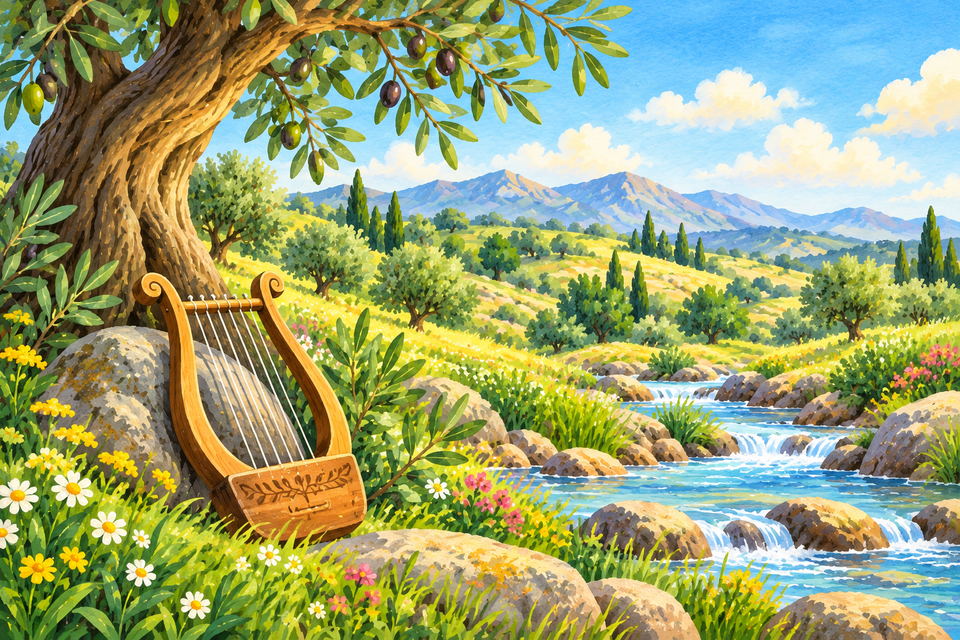
This poem speaks in shifting voices that ask, answer and praise. Garden images, city names and bright comparisons express delight and belonging without turning the song into a story beyond what the passage itself says.
Understanding the passage
Read these words in context
Friends ask where the beloved has gone so they can seek him too. The woman answers with garden imagery and states, “I am my beloved’s, and my beloved is mine.” The lover then praises her beauty and uniqueness. The passage closes with a return call to the Shulammite and a final question about gazing at her.
Song of Solomon 6:1–13Main takeaway
This passage uses poetic images to express seeking, belonging and honouring another person as uniquely precious.
Explore the poem and its images
Open a card to explore the full explanation and its Bible references.
01The search answered in garden languageThe friends ask where the beloved has gone and where he has turned. The answer does not give a travel report but a poetic picture: he has gone to his garden, among spice beds, gardens and lilies.
Explanation
The friends ask where the beloved has gone and where he has turned. The answer does not give a travel report but a poetic picture: he has gone to his garden, among spice beds, gardens and lilies. Then comes a clear line of mutual belonging: “I am my beloved’s, and my beloved is mine.”
02Praise through striking comparisonsThe lover praises the woman as beautiful and lovely, comparing her to Tirzah and Jerusalem, and also “awesome as an army with banners”.
Explanation
The lover praises the woman as beautiful and lovely, comparing her to Tirzah and Jerusalem, and also “awesome as an army with banners”. Her eyes affect him deeply. He continues with images for hair, teeth and temples. These comparisons are poetic compliments, using familiar sights to express admiration.
03One stands out, then the song turns againAfter mentioning many queens, concubines and countless virgins, the poem says this woman is unique, praised by others and called blessed.
Explanation
After mentioning many queens, concubines and countless virgins, the poem says this woman is unique, praised by others and called blessed. Another voice compares her to morning, moon and sun. The passage ends with movement to a grove, an unexplained line about chariots, and repeated calls for the Shulammite to return.
Questions to explore
Pause, look back at the verses and talk together.
01How does the passage answer the friends’ question about where the beloved has gone?
Notice that the answer uses garden words such as spices, gardens and lilies, rather than giving plain directions.
02What exact words show mutual belonging between the two people in the poem?
Quote the line itself and consider why it stands out before the long section of praise.
03Which phrases show that the woman is presented as unique among many others?
Look for the contrast between the large numbers in verse 8 and words like “unique”, “only daughter”, “blessed” and “praised” in verse 9.
Read the Bible passage
World English Bible ClassicScripture quotation · Public domain
Song of Solomon 6:1–13
1Where has your beloved gone, you fairest among women? Where has your beloved turned, that we may seek him with you? Beloved
2My beloved has gone down to his garden, to the beds of spices, to pasture his flock in the gardens, and to gather lilies.
3I am my beloved’s, and my beloved is mine. He browses among the lilies. Lover
4You are beautiful, my love, as Tirzah, lovely as Jerusalem, awesome as an army with banners.
5Turn away your eyes from me, for they have overcome me. Your hair is like a flock of goats, that lie along the side of Gilead.
6Your teeth are like a flock of ewes, which have come up from the washing, of which every one has twins; not one is bereaved among them.
7Your temples are like a piece of a pomegranate behind your veil.
8There are sixty queens, eighty concubines, and virgins without number.
9My dove, my perfect one, is unique. She is her mother’s only daughter. She is the favorite one of her who bore her. The daughters saw her, and called her blessed. The queens and the concubines saw her, and they praised her.
10Who is she who looks out as the morning, beautiful as the moon, clear as the sun, and awesome as an army with banners?
11I went down into the nut tree grove, to see the green plants of the valley, to see whether the vine budded, and the pomegranates were in flower.
12Without realizing it, my desire set me with my royal people’s chariots. Friends
13Return, return, Shulammite! Return, return, that we may gaze at you. Lover Why do you desire to gaze at the Shulammite, as at the dance of Mahanaim?