Single lesson
Esther and Mordecai: Deliverance and Purim
Esther 7:1–10; Esther 8:1–17; Esther 9:1–10:3
A brave queen helps her people. This lesson also brings together Esther and Mordecai Help Their People, Deliverance and the Festival of Purim.
Before you teach
Esther was queen when a terrible order threatened to destroy the Jews. Mordecai told her what had happened and asked her to appeal to the king for her people. Going to the king without being summoned was dangerous. Esther knew she could be put to death unless the king held out his golden sceptre. Esther asked Mordecai to gather the Jews in Susa and fast for her for three days. She and her attendants would fast too. Then she put on her royal clothes and entered the court. The king…
Explain the central teaching of Esther and Mordecai: Deliverance and Purim, using two details from the reading. A brave queen helps her people. A brave queen helps her people. When a day planned for the Jews’ destruction arrived, the outcome was reversed, and those days were remembered as Purim.
Welcome: Esther and Mordecai: Deliverance and Purim
5 minIntroduce “Esther Exposes Haman”, “Esther and Mordecai Help Their People”, “Deliverance and the Festival of Purim” and locate Esther 7:1–10; Esther 8:1–17; Esther 9:1–10:3. A brave queen helps her people. Invite each learner to name a detail or question they will listen for.
Esther 7:1, Esther 7:6, Esther 7:10
Read and explain the passage
12 minEsther Exposes Haman (Esther 7:1–10): Esther was queen when a terrible order threatened to destroy the Jews. Mordecai told her what had happened and asked her to appeal to the king for her people. Going to the king without being summoned was dangerous. Esther knew she could be put to death unless the king held out his golden sceptre.
Esther and Mordecai Help Their People (Esther 8:1–17): Esther was queen when a terrible order threatened to destroy the Jews. Mordecai told her what had happened and asked her to appeal to the king for her people. Going to the king without being summoned was dangerous. Esther knew she could be put to death unless the king held out his golden sceptre.
Deliverance and the Festival of Purim (Esther 9:1–10:3): In the month of Adar, on the day the king’s decree was to be carried out, the enemies of the Jews expected to overpower them. Instead, the opposite happened. The Jews gathered in their cities across the empire to defend themselves, and no one could stand against them. Officials also helped them, because fear of Mordecai had spread as he became great in the king’s house.
Read the selected verses together, pausing at “Esther Exposes Haman”, “Esther and Mordecai Help Their People”, “Deliverance and the Festival of Purim”. Use the source reading below and check the explanation against the words of the passage.
Esther 7:4, Esther 7:2, Esther 7:8, Esther 8:1, Esther 8:4, Esther 8:7, Esther 9:1, Esther 9:2, Esther 9:15
Discuss the details and their meaning
8 minUse the three questions below. Begin with ““Esther asked Mordecai to gather the Jews in Susa and fast for her for three days.” Which details explain how the account reaches this point?” and allow time to find the supporting verses. When a day planned for the Jews’ destruction arrived, the outcome was reversed, and those days were remembered as Purim. Ask learners to explain which details support their answer and to identify a question they would like to explore further.
Esther 7:9, Esther 7:8, Esther 7:4, Esther 8:3, Esther 8:1, Esther 8:2, Esther 10:3, Esther 9:31, Esther 9:30
Make and respond: Choices and outcomes evidence map
12 minWork on “Esther and Mordecai: Deliverance and Purim: Choices and outcomes evidence map”. Follow the materials and steps below, using “Esther Exposes Haman”, “Esther and Mordecai Help Their People”, “Deliverance and the Festival of Purim” as reading headings. Each learner should include at least two accurate details and their verse references. Share one observation from the finished sheet and explain how it connects with the central teaching.
Esther 7:1, Esther 9:5, Esther 10:3
Closing: return to Deliverance and the Festival of Purim
3 minRevisit Esther 9:1–10:3. Invite a learner to summarise what the group has learned about Deliverance and the Festival of Purim and another to support the summary with a verse. Give learners a moment to complete their response sheet. They can share a question or, if appropriate for the group, join the optional prayer.
Esther 9:1, Esther 9:18, Esther 10:3
Questions to explore
“Esther asked Mordecai to gather the Jews in Susa and fast for her for three days.” Which details explain how the account reaches this point?
Esther asked Mordecai to gather the Jews in Susa and fast for her for three days. She and her attendants would fast too. Then she put on her royal clothes and entered the court. The king held out his golden sceptre, and Esther approached him.
Esther 7:9, Esther 7:8, Esther 7:4
How does this moment affect the rest of the account: “The king was furious.”?
The king was furious. Haman was put to death on the gallows he had prepared for Mordecai. The king gave Mordecai the royal signet ring that Haman had held. But the earlier order against the Jews still stood. Esther came before the king again, weeping and pleading for her people.
Esther 8:3, Esther 8:1, Esther 8:2
“Esther the queen, the daughter of Abihail, and Mordecai confirmed these days of Purim with full authority.” How does this ending connect with the beginning?
Esther the queen, the daughter of Abihail, and Mordecai confirmed these days of Purim with full authority. Letters went to the Jews in the king’s one hundred and twenty-seven provinces, confirming the appointed days along with the matter of fastings and mourning. The command was written down. After this, King Ahasuerus laid tribute on the land and the islands, and Mordecai remained next to the…
Esther 10:3, Esther 9:31, Esther 9:30
Make, think or respond
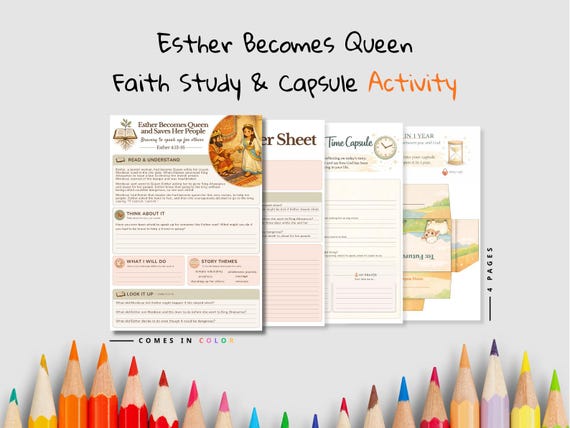
Esther and Mordecai: Deliverance and Purim: Choices and outcomes evidence map
What you’ll need
- plain paper or card
- pencils or pens
- a Bible or the source reading on this page
Try it together
- Fold a sheet into three panels or draw three columns. Label them “Words or actions”, “What happens next”, “Verse reference”.
- Read Esther 7:1–10; Esther 8:1–17; Esther 9:1–10:3. Use “Esther Exposes Haman”, “Esther and Mordecai Help Their People”, “Deliverance and the Festival of Purim” as your reading headings and add a short quotation or detail with its verse reference to each panel.
- Compare your notes with a partner. Check that every quotation is accurate and every conclusion has support in the passage.
- Compare two actions or statements in the account and explain their different outcomes.
The finished sheet keeps the details of Esther and Mordecai: Deliverance and Purim connected to their Bible references and gives the group a way to explain what they noticed.
Adapt for your group
- For learners who need more support, prepare the reading headings “Esther Exposes Haman”, “Esther and Mordecai Help Their People”, “Deliverance and the Festival of Purim” and let them match short quotations to the correct heading.
- For confident readers, compare two sections of Esther 7:1–10; Esther 8:1–17; Esther 9:1–10:3. Ask for a written explanation with two supporting references and one question that the text leaves open.
An optional closing prayer
“God, help us listen carefully as we read Esther 7:1–10; Esther 8:1–17; Esther 9:1–10:3. Help us understand what we have read, ask thoughtful questions and respond with care for others. Amen.”
Read the Bible passage World English Bible Classic
Esther 7
1 So the king and Haman came to banquet with Esther the queen.
2 The king said again to Esther on the second day at the banquet of wine, “What is your petition, queen Esther? It shall be granted you. What is your request? Even to the half of the kingdom it shall be performed.”
3 Then Esther the queen answered, “If I have found favor in your sight, O king, and if it pleases the king, let my life be given me at my petition, and my people at my request.
4 For we are sold, I and my people, to be destroyed, to be slain, and to perish. But if we had been sold for male and female slaves, I would have held my peace, although the adversary could not have compensated for the king’s loss.”
5 Then King Ahasuerus said to Esther the queen, “Who is he, and where is he who dared presume in his heart to do so?”
6 Esther said, “An adversary and an enemy, even this wicked Haman!” Then Haman was afraid before the king and the queen.
7 The king arose in his wrath from the banquet of wine and went into the palace garden. Haman stood up to make request for his life to Esther the queen, for he saw that there was evil determined against him by the king.
8 Then the king returned out of the palace garden into the place of the banquet of wine; and Haman had fallen on the couch where Esther was. Then the king said, “Will he even assault the queen in front of me in the house?” As the word went out of the king’s mouth, they covered Haman’s face.
9 Then Harbonah, one of the eunuchs who were with the king, said, “Behold, the gallows fifty cubits high, which Haman has made for Mordecai, who spoke good for the king, is standing at Haman’s house.” The king said, “Hang him on it!”
10 So they hanged Haman on the gallows that he had prepared for Mordecai. Then the king’s wrath was pacified.
Esther 8
1 On that day, King Ahasuerus gave the house of Haman, the Jews’ enemy, to Esther the queen. Mordecai came before the king; for Esther had told what he was to her.
2 The king took off his ring, which he had taken from Haman, and gave it to Mordecai. Esther set Mordecai over the house of Haman.
3 Esther spoke yet again before the king, and fell down at his feet and begged him with tears to put away the mischief of Haman the Agagite, and his plan that he had planned against the Jews.
4 Then the king held out to Esther the golden scepter. So Esther arose, and stood before the king.
5 She said, “If it pleases the king, and if I have found favor in his sight, and the thing seems right to the king, and I am pleasing in his eyes, let it be written to reverse the letters devised by Haman, the son of Hammedatha the Agagite, which he wrote to destroy the Jews who are in all the king’s provinces.
6 For how can I endure to see the evil that would come to my people? How can I endure to see the destruction of my relatives?”
7 Then King Ahasuerus said to Esther the queen and to Mordecai the Jew, “See, I have given Esther the house of Haman, and they have hanged him on the gallows because he laid his hand on the Jews.
8 Write also to the Jews as it pleases you, in the king’s name, and seal it with the king’s ring; for the writing which is written in the king’s name, and sealed with the king’s ring, may not be reversed by any man.”
9 Then the king’s scribes were called at that time, in the third month, which is the month Sivan, on the twenty-third day of the month; and it was written according to all that Mordecai commanded to the Jews, and to the local governors, and the governors and princes of the provinces which are from India to Ethiopia, one hundred twenty-seven provinces, to every province according to its writing, and to every people in their language, and to the Jews in their writing, and in their language.
10 He wrote in the name of King Ahasuerus, and sealed it with the king’s ring, and sent letters by courier on horseback, riding on royal horses that were bred from swift steeds.
11 In those letters, the king granted the Jews who were in every city to gather themselves together and to defend their lives—to destroy, to kill, and to cause to perish all the power of the people and province that would assault them, their little ones and women, and to plunder their possessions,
12 on one day in all the provinces of King Ahasuerus, on the thirteenth day of the twelfth month, which is the month Adar.
13 A copy of the letter, that the decree should be given out in every province, was published to all the peoples, that the Jews should be ready for that day to avenge themselves on their enemies.
14 So the couriers who rode on royal horses went out, hastened and pressed on by the king’s commandment. The decree was given out in the citadel of Susa.
15 Mordecai went out of the presence of the king in royal clothing of blue and white, and with a great crown of gold, and with a robe of fine linen and purple; and the city of Susa shouted and was glad.
16 The Jews had light, gladness, joy, and honor.
17 In every province and in every city, wherever the king’s commandment and his decree came, the Jews had gladness, joy, a feast and a holiday. Many from among the peoples of the land became Jews, for the fear of the Jews had fallen on them.
Esther 9
1 Now in the twelfth month, which is the month Adar, on the thirteenth day of the month, when the king’s commandment and his decree came near to be put in execution, on the day that the enemies of the Jews hoped to conquer them, (but it turned out that the opposite happened, that the Jews conquered those who hated them),
2 the Jews gathered themselves together in their cities throughout all the provinces of the King Ahasuerus, to lay hands on those who wanted to harm them. No one could withstand them, because the fear of them had fallen on all the people.
3 All the princes of the provinces, the local governors, the governors, and those who did the king’s business helped the Jews, because the fear of Mordecai had fallen on them.
4 For Mordecai was great in the king’s house, and his fame went out throughout all the provinces, for the man Mordecai grew greater and greater.
5 The Jews struck all their enemies with the stroke of the sword, and with slaughter and destruction, and did what they wanted to those who hated them.
6 In the citadel of Susa, the Jews killed and destroyed five hundred men.
7 They killed Parshandatha, Dalphon, Aspatha,
8 Poratha, Adalia, Aridatha,
9 Parmashta, Arisai, Aridai, and Vaizatha,
10 the ten sons of Haman the son of Hammedatha, the Jews’ enemy, but they didn’t lay their hand on the plunder.
11 On that day, the number of those who were slain in the citadel of Susa was brought before the king.
12 The king said to Esther the queen, “The Jews have slain and destroyed five hundred men in the citadel of Susa, including the ten sons of Haman; what then have they done in the rest of the king’s provinces! Now what is your petition? It shall be granted you. What is your further request? It shall be done.”
13 Then Esther said, “If it pleases the king, let it be granted to the Jews who are in Susa to do tomorrow also according to today’s decree, and let Haman’s ten sons be hanged on the gallows.”
14 The king commanded this to be done. A decree was given out in Susa; and they hanged Haman’s ten sons.
15 The Jews who were in Susa gathered themselves together on the fourteenth day also of the month Adar, and killed three hundred men in Susa; but they didn’t lay their hand on the plunder.
16 The other Jews who were in the king’s provinces gathered themselves together, defended their lives, had rest from their enemies, and killed seventy-five thousand of those who hated them; but they didn’t lay their hand on the plunder.
17 This was done on the thirteenth day of the month Adar; and on the fourteenth day of that month they rested and made it a day of feasting and gladness.
18 But the Jews who were in Susa assembled together on the thirteenth and on the fourteenth days of the month; and on the fifteenth day of that month, they rested, and made it a day of feasting and gladness.
19 Therefore the Jews of the villages, who live in the unwalled towns, make the fourteenth day of the month Adar a day of gladness and feasting, a holiday, and a day of sending presents of food to one another.
20 Mordecai wrote these things, and sent letters to all the Jews who were in all the provinces of the King Ahasuerus, both near and far,
21 to enjoin them that they should keep the fourteenth and fifteenth days of the month Adar yearly,
22 as the days in which the Jews had rest from their enemies, and the month which was turned to them from sorrow to gladness, and from mourning into a holiday; that they should make them days of feasting and gladness, and of sending presents of food to one another, and gifts to the needy.
23 The Jews accepted the custom that they had begun, as Mordecai had written to them,
24 because Haman the son of Hammedatha, the Agagite, the enemy of all the Jews, had plotted against the Jews to destroy them, and had cast “Pur”, that is the lot, to consume them and to destroy them;
25 but when this became known to the king, he commanded by letters that his wicked plan, which he had planned against the Jews, should return on his own head, and that he and his sons should be hanged on the gallows.
26 Therefore they called these days “Purim”, from the word “Pur.” Therefore because of all the words of this letter, and of that which they had seen concerning this matter, and that which had come to them,
27 the Jews established and imposed on themselves, on their descendants, and on all those who joined themselves to them, so that it should not fail that they would keep these two days according to what was written and according to its appointed time every year;
28 and that these days should be remembered and kept throughout every generation, every family, every province, and every city; and that these days of Purim should not fail from among the Jews, nor their memory perish from their offspring.
29 Then Esther the queen, the daughter of Abihail, and Mordecai the Jew wrote with all authority to confirm this second letter of Purim.
30 He sent letters to all the Jews in the hundred twenty-seven provinces of the kingdom of Ahasuerus with words of peace and truth,
31 to confirm these days of Purim in their appointed times, as Mordecai the Jew and Esther the queen had decreed, and as they had imposed upon themselves and their descendants in the matter of the fastings and their mourning.
32 The commandment of Esther confirmed these matters of Purim; and it was written in the book.
Esther 10
1 King Ahasuerus laid a tribute on the land and on the islands of the sea.
2 Aren’t all the acts of his power and of his might, and the full account of the greatness of Mordecai, to which the king advanced him, written in the book of the chronicles of the kings of Media and Persia?
3 For Mordecai the Jew was next to King Ahasuerus, and great among the Jews and accepted by the multitude of his brothers, seeking the good of his people and speaking peace to all his descendants.
World English Bible Classic. Public domain.
Source passages
Other Scripture references
Esther (Greek) 7:1–10; Esther 8:1–17 Esther (Greek) 8:1–12; Esther (Greek) 8:14–17; Esther 9:1–10:3 Esther (Greek) 9:1–10:3
Something to make together
These activities connect with the passage. Choose one that suits your group and the time you have.