Single lesson
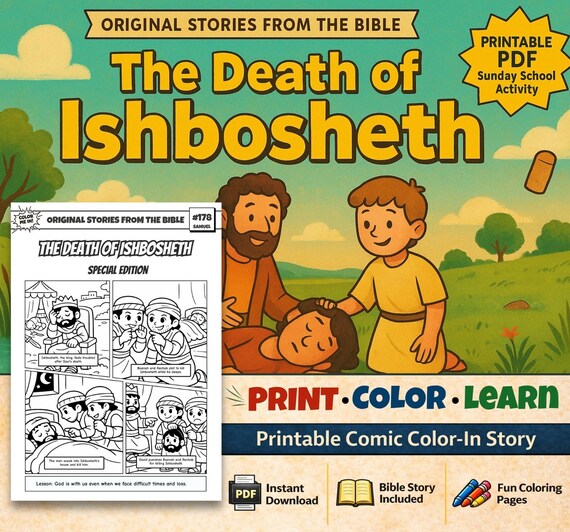
Ish-bosheth Is Killed
2 Samuel 4:1–12
After Ish-bosheth was killed, David made it clear that he would not welcome murder as a path to the throne.
Before you teach
When Saul's son Ish-bosheth heard that Abner had died in Hebron, he became weak with fear, and all Israel was troubled. The chapter also pauses to mention Jonathan's son Mephibosheth, who had become lame in both feet after a fall when his nurse fled with him years earlier. Ish-bosheth had two captains of raiding bands named Rechab and Baanah. They were brothers, sons of Rimmon the Beerothite, from a place counted as part of Benjamin. The passage adds that the Beerothites had fled to Gittaim and lived there as foreigners.
Explain the central teaching of Ish-bosheth Is Killed, using two details from the reading. After Ish-bosheth was killed, David made it clear that he would not welcome murder as a path to the throne.
Welcome: Ish-bosheth Is Killed
5 minIntroduce “Ish-bosheth Is Killed” and locate 2 Samuel 4:1–12. After Ish-bosheth was killed, David made it clear that he would not welcome murder as a path to the throne. Invite each learner to name a detail or question they will listen for.
2 Samuel 4:1, 2 Samuel 4:7, 2 Samuel 4:12
Read and explain the passage
12 minWhen Saul's son Ish-bosheth heard that Abner had died in Hebron, he became weak with fear, and all Israel was troubled. The chapter also pauses to mention Jonathan's son Mephibosheth, who had become lame in both feet after a fall when his nurse fled with him years earlier.
At about the heat of the day, while Ish-bosheth was resting at noon, Rechab and Baanah came to his house. They went into the middle of the house as though they had business there, struck him as he lay on his bed in his bedroom, killed him, cut off his head, and escaped by travelling through the night.
Then David said that these men had killed a righteous man in his own house on his own bed, so they would answer for his blood. David ordered his young men to kill them. Their hands and feet were cut off, and their bodies were hung beside the pool in Hebron. Ish-bosheth's head, however, was buried in Abner's grave in Hebron. How does this passage show that David would not call evil good, even when it seemed to help him?
Read the selected verses together, pausing at “Ish-bosheth Is Killed”. Use the source reading below and check the explanation against the words of the passage.
2 Samuel 4:4, 2 Samuel 4:1, 2 Samuel 4:2, 2 Samuel 4:7, 2 Samuel 4:6, 2 Samuel 4:5, 2 Samuel 4:12, 2 Samuel 4:11
Discuss the details and their meaning
8 minUse the three questions below. Begin with ““Ish-bosheth had two captains of raiding bands named Rechab and Baanah.” Which details explain how the account reaches this point?” and allow time to find the supporting verses. After Ish-bosheth was killed, David made it clear that he would not welcome murder as a path to the throne. Ask learners to explain which details support their answer and to identify a question they would like to explore further.
2 Samuel 4:2, 2 Samuel 4:3, 2 Samuel 4:5, 2 Samuel 4:7, 2 Samuel 4:6, 2 Samuel 4:12, 2 Samuel 4:11
Make and respond: Choices and outcomes evidence map
12 minWork on “Ish-bosheth Is Killed: Choices and outcomes evidence map”. Follow the materials and steps below, using “Ish-bosheth Is Killed” as reading headings. Each learner should include at least two accurate details and their verse references. Share one observation from the finished sheet and explain how it connects with the central teaching.
2 Samuel 4:1, 2 Samuel 4:7, 2 Samuel 4:12
Closing: return to Ish-bosheth Is Killed
3 minRevisit 2 Samuel 4:1–12. Invite a learner to summarise what the group has learned about Ish-bosheth Is Killed and another to support the summary with a verse. Give learners a moment to complete their response sheet. They can share a question or, if appropriate for the group, join the optional prayer.
2 Samuel 4:1, 2 Samuel 4:7, 2 Samuel 4:12
Questions to explore
“Ish-bosheth had two captains of raiding bands named Rechab and Baanah.” Which details explain how the account reaches this point?
Ish-bosheth had two captains of raiding bands named Rechab and Baanah. They were brothers, sons of Rimmon the Beerothite, from a place counted as part of Benjamin. The passage adds that the Beerothites had fled to Gittaim and lived there as foreigners.
2 Samuel 4:2, 2 Samuel 4:3, 2 Samuel 4:5
How does this moment affect the rest of the account: “At about the heat of the day, while Ish-bosheth was resting at noon, Rechab and Baanah came to his house.”?
At about the heat of the day, while Ish-bosheth was resting at noon, Rechab and Baanah came to his house. They went into the middle of the house as though they had business there, struck him as he lay on his bed in his bedroom, killed him, cut off his head, and escaped by travelling through the night.
2 Samuel 4:7, 2 Samuel 4:6, 2 Samuel 4:5
How does this passage show that David would not call evil good, even when it seemed to help him?
Then David said that these men had killed a righteous man in his own house on his own bed, so they would answer for his blood. David ordered his young men to kill them. Their hands and feet were cut off, and their bodies were hung beside the pool in Hebron. Ish-bosheth's head, however, was buried in Abner's grave in Hebron.
2 Samuel 4:12, 2 Samuel 4:11, 2 Samuel 4:7
Make, think or respond
Ish-bosheth Is Killed: Choices and outcomes evidence map
What you’ll need
- plain paper or card
- pencils or pens
- a Bible or the source reading on this page
Try it together
- Fold a sheet into three panels or draw three columns. Label them “Words or actions”, “What happens next”, “Verse reference”.
- Read 2 Samuel 4:1–12. Use “Ish-bosheth Is Killed” as your reading headings and add a short quotation or detail with its verse reference to each panel.
- Compare your notes with a partner. Check that every quotation is accurate and every conclusion has support in the passage.
- Compare two actions or statements in the account and explain their different outcomes.
The finished sheet keeps the details of Ish-bosheth Is Killed connected to their Bible references and gives the group a way to explain what they noticed.
Adapt for your group
- For learners who need more support, prepare the reading headings “Ish-bosheth Is Killed” and let them match short quotations to the correct heading.
- For confident readers, compare two sections of 2 Samuel 4:1–12. Ask for a written explanation with two supporting references and one question that the text leaves open.
An optional closing prayer
“God, help us listen carefully as we read 2 Samuel 4:1–12. Help us understand what we have read, ask thoughtful questions and respond with care for others. Amen.”
Read the Bible passage World English Bible Classic
2 Samuel 4
1 When Saul’s son heard that Abner was dead in Hebron, his hands became feeble, and all the Israelites were troubled.
2 Saul’s son had two men who were captains of raiding bands. The name of one was Baanah and the name of the other Rechab, the sons of Rimmon the Beerothite, of the children of Benjamin (for Beeroth also is considered a part of Benjamin;
3 and the Beerothites fled to Gittaim, and have lived as foreigners there until today).
4 Now Jonathan, Saul’s son, had a son who was lame in his feet. He was five years old when the news came about Saul and Jonathan out of Jezreel; and his nurse picked him up and fled. As she hurried to flee, he fell and became lame. His name was Mephibosheth.
5 The sons of Rimmon the Beerothite, Rechab and Baanah, went out and came at about the heat of the day to the house of Ishbosheth as he took his rest at noon.
6 They came there into the middle of the house as though they would have fetched wheat, and they struck him in the body; and Rechab and Baanah his brother escaped.
7 Now when they came into the house as he lay on his bed in his bedroom, they struck him, killed him, beheaded him, and took his head, and went by the way of the Arabah all night.
8 They brought the head of Ishbosheth to David to Hebron, and said to the king, “Behold, the head of Ishbosheth, the son of Saul, your enemy, who sought your life! Yahweh has avenged my lord the king today of Saul and of his offspring.”
9 David answered Rechab and Baanah his brother, the sons of Rimmon the Beerothite, and said to them, “As Yahweh lives, who has redeemed my soul out of all adversity,
10 when someone told me, ‘Behold, Saul is dead,’ thinking that he brought good news, I seized him and killed him in Ziklag, which was the reward I gave him for his news.
11 How much more, when wicked men have slain a righteous person in his own house on his bed, should I not now require his blood from your hand, and rid the earth of you?”
12 David commanded his young men, and they killed them, cut off their hands and their feet, and hanged them up beside the pool in Hebron. But they took the head of Ishbosheth and buried it in Abner’s grave in Hebron.
World English Bible Classic. Public domain.
Source passages
Something to make together
These activities connect with the passage. Choose one that suits your group and the time you have.