Single lesson
The Good Samaritan: Being a Neighbour
Luke 10:25–37
Jesus answers a question about loving your neighbour by telling a parable. In this lesson, children will notice the Samaritan’s practical acts of mercy and consider what it looks like to show mercy in everyday situations.
Before you teach
In Luke 10:25-29, a lawyer asks Jesus what he should do to inherit eternal life. Jesus points him to the law: love God fully and love your neighbour as yourself. When the man asks, “Who is my neighbour?”, Jesus answers with a parable about mercy.
Students will be able to identify at least three practical ways the Samaritan showed mercy and name one way they can show mercy this week.
Welcome: What does a good neighbour do?
5 minBegin by asking children for simple examples of helpful actions: noticing, stopping, helping, sharing, or caring. Explain that Jesus was asked who a neighbour is. Tell the group they will listen for what the Samaritan actually did, not just how he may have felt. This prepares them to hear the parable carefully.
Luke 10:29, Luke 10:33, Luke 10:37
Read and explain: Jesus’ parable of mercy
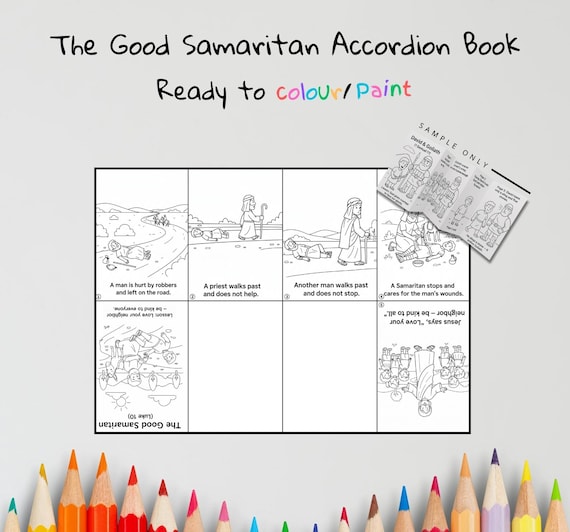
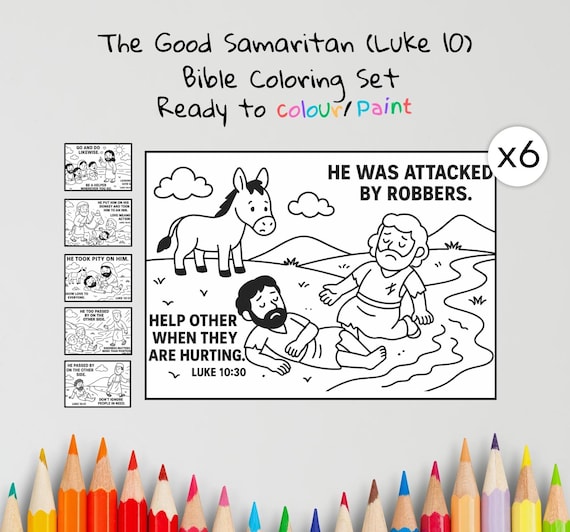
8 minRead Luke 10:30-35 aloud slowly. Explain that this is a parable Jesus told in response to the question in verse 29. Trace the actions in order: the injured man is left half dead, the priest sees and passes by, the Levite sees and passes by, and the Samaritan sees, has compassion, bandages wounds, carries him, brings him to an inn, and pays for his care.
Luke 10:29, Luke 10:30, Luke 10:31, Luke 10:32, Luke 10:33, Luke 10:34, Luke 10:35
Discuss: Which person acted like a neighbour?
6 minAsk children to compare the three travellers using only the details in the passage. Help them notice that Jesus’ question in verse 36 is not “Who counts as my neighbour?” but who proved to be a neighbour. The answer is the one who showed mercy. Emphasise that mercy here included seeing a need and taking practical action.
Luke 10:31, Luke 10:32, Luke 10:33, Luke 10:36, Luke 10:37
Make and respond: Kindness kit and helping choices
8 minChildren make a small “kindness kit” reminder and sort through age-appropriate helping scenarios. Invite them to match each scenario with a practical act such as noticing, going over, helping, or giving. Make clear that this activity is an application of Jesus’ command, not part of the Bible story itself. Aim for specific, safe acts of mercy children can do.
Luke 10:33, Luke 10:34, Luke 10:35, Luke 10:37
Closing: Go and do likewise
3 minReview the Samaritan’s actions as a list: he saw, had compassion, came to the man, treated wounds, carried him, brought him somewhere safe, took care of him, and paid for further care. Ask each child to choose one practical action they can do this week. Close by repeating Jesus’ words, “Go and do likewise.”
Luke 10:33, Luke 10:34, Luke 10:35, Luke 10:37
Questions to explore
What did the Samaritan do after he saw the injured man?
Look closely at the sequence in the text and list the actions one by one from compassion to ongoing care.
Luke 10:33, Luke 10:34, Luke 10:35
How were the priest and the Levite different from the Samaritan in this parable?
Compare what each person did after seeing the injured man.
Luke 10:31, Luke 10:32, Luke 10:33
According to Jesus, who was a neighbour to the injured man?
Use Jesus’ question in verse 36 and the lawyer’s answer in verse 37.
Luke 10:36, Luke 10:37
Make, think or respond
Kindness Kit and Mercy Match
What you’ll need
- paper or card
- pencils or crayons
- small envelope or folded paper pouch
- sticky notes or scrap paper
- bandage or tissue optional
Try it together
- Write or draw four words from the parable on a small card: see, come near, care, give.
- Make a simple envelope or folded pouch to hold the card and a few sticky notes.
- Read out everyday helping scenarios such as someone left out at play or someone who drops their things, and ask children which action from the card fits best.
- Children add one sticky note naming a safe, practical act of mercy they can do this week and place it in the pouch.
The Samaritan’s mercy was practical and active, so this activity helps children remember concrete ways to respond to others with care in everyday life.
Adapt for your group
- For younger children, shorten the discussion and use picture actions only: saw, helped, cared, gave.
- For older children, ask them to support each answer with the exact verse that shows the Samaritan’s action or Jesus’ conclusion.
An optional closing prayer
Suggested prayer: “Lord Jesus, please help us to see people who need help and to show mercy in practical ways. Help us to do likewise. Amen.”
Read the Bible passage World English Bible Classic
Luke 10
25 Behold, a certain lawyer stood up and tested him, saying, “Teacher, what shall I do to inherit eternal life?”
26 He said to him, “What is written in the law? How do you read it?”
27 He answered, “You shall love the Lord your God with all your heart, with all your soul, with all your strength, and with all your mind; and your neighbor as yourself.”
28 He said to him, “You have answered correctly. Do this, and you will live.”
29 But he, desiring to justify himself, asked Jesus, “Who is my neighbor?”
30 Jesus answered, “A certain man was going down from Jerusalem to Jericho, and he fell among robbers, who both stripped him and beat him, and departed, leaving him half dead.
31 By chance a certain priest was going down that way. When he saw him, he passed by on the other side.
32 In the same way a Levite also, when he came to the place and saw him, passed by on the other side.
33 But a certain Samaritan, as he traveled, came where he was. When he saw him, he was moved with compassion,
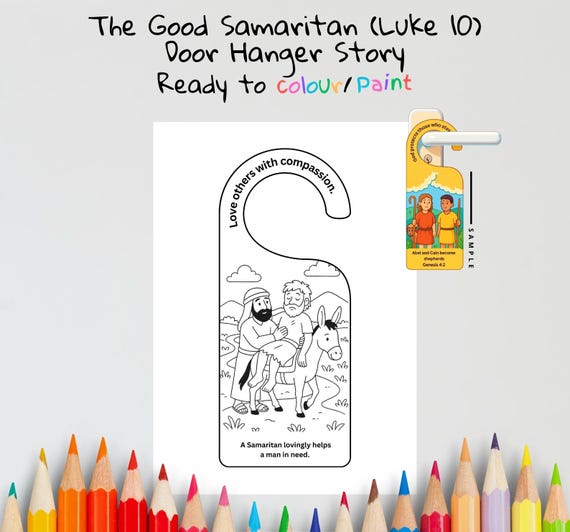
34 came to him, and bound up his wounds, pouring on oil and wine. He set him on his own animal, brought him to an inn, and took care of him.
35 On the next day, when he departed, he took out two denarii, gave them to the host, and said to him, ‘Take care of him. Whatever you spend beyond that, I will repay you when I return.’
36 Now which of these three do you think seemed to be a neighbor to him who fell among the robbers?”
37 He said, “He who showed mercy on him.” Then Jesus said to him, “Go and do likewise.”
World English Bible Classic. Public domain.
Source passages
Something to make together
These activities connect with the passage. Choose one that suits your group and the time you have.