Single lesson
The Riot in Ephesus
Acts 19:21–41
In this lesson, children will follow the riot in Ephesus step by step, notice how people reacted, and compare confused shouting with calm, lawful words. They will also consider Paul being determined in the Spirit at the start of the passage.
Before you teach
Acts 19:21–41 begins with Paul’s travel plans. He sent Timothy and Erastus into Macedonia and stayed in Asia a while. During that time, a serious disturbance arose in Ephesus concerning the Way. Demetrius the silversmith gathered craftsmen and spoke about their trade, wealth, and the honour of Artemis.
Students will be able to sequence Acts 19:21–41, name at least two choices and outcomes in the passage, and compare Paul’s resolve in Acts 19:21 with the crowd’s confusion and the town clerk’s call for order.
Welcome: A disturbance concerning the Way
5 minShow the title and explain that this is a Bible account about a city crowd. Tell the children to listen for what the trouble was about. Read Acts 19:21–27. Point out that Paul was determined in the Spirit about his journey, and that a disturbance arose concerning the Way when Demetrius spoke about business, wealth, and Artemis.
Acts 19:21, Acts 19:22, Acts 19:23, Acts 19:24, Acts 19:25, Acts 19:26, Acts 19:27
Read and explain: Anger, shouting, and confusion
7 minRead Acts 19:28–34 aloud. Ask children to listen for repeated words and actions. Note that the craftsmen became angry and cried out, the city was filled with confusion, and many people did not know why they had gathered. Paul wanted to enter, but the disciples and some of his friends urged him not to.
Acts 19:28, Acts 19:29, Acts 19:30, Acts 19:31, Acts 19:32, Acts 19:33, Acts 19:34
Discuss: Choices, outcomes, and what we learn
6 minTalk through the choices in order. Demetrius gathered the craftsmen and stirred concern. The crowd rushed together and shouted. Paul wanted to go in, but others stopped him. The town clerk quieted the crowd. Help children notice what the passage shows about anger, confusion, friendship, warning, and a move towards an orderly process.
Acts 19:25, Acts 19:28, Acts 19:29, Acts 19:30, Acts 19:31, Acts 19:35, Acts 19:36, Acts 19:38, Acts 19:39
Make and respond: Riot sequence cards
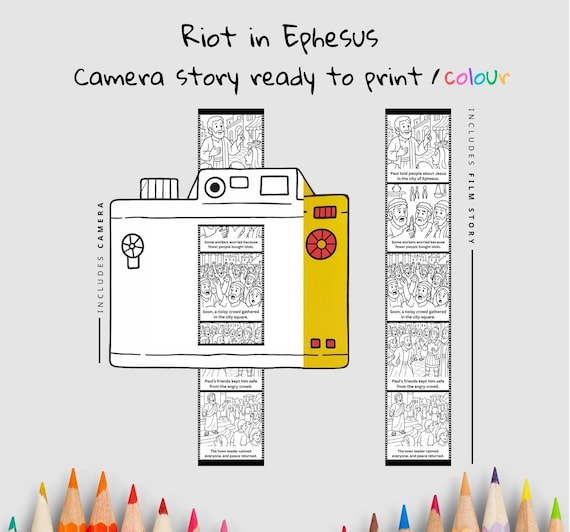
8 minChildren make simple sequence cards showing key moments from the passage, then place them in order and retell the account in pairs. Encourage them to include who acted, what happened next, and how the situation ended. Finish by asking which actions increased confusion and which words helped bring the assembly to an end.
Acts 19:23, Acts 19:28, Acts 19:29, Acts 19:32, Acts 19:35, Acts 19:36, Acts 19:41
Closing: From confusion to dismissal
4 minSummarise the account together: a disturbance arose concerning the Way, the crowd became confused, Paul was restrained from entering, and the town clerk dismissed the assembly. Invite each child to name one choice in the passage and its outcome. You may also ask what warning the town clerk gave about acting rashly and about the riot itself.
Acts 19:23, Acts 19:30, Acts 19:31, Acts 19:32, Acts 19:36, Acts 19:40, Acts 19:41
Questions to explore
What reason did Demetrius give for gathering the craftsmen?
Look for the words about business, wealth, and what Paul had been saying about gods made with hands.
Acts 19:24, Acts 19:25, Acts 19:26, Acts 19:27
How does the passage show that the crowd was confused?
Find the verse that says people cried different things and that most of them did not know why they had come together.
Acts 19:32
How do Paul’s resolve, the crowd’s actions, and the town clerk’s words differ in this passage?
Compare Paul being determined in the Spirit with the anger and confusion of the crowd, then notice the call to be quiet and use the proper assembly or the courts.
Acts 19:21, Acts 19:28, Acts 19:32, Acts 19:36, Acts 19:38, Acts 19:39
Make, think or respond
Riot Sequence Cards
What you’ll need
- plain paper or card
- pencils or markers
- Bible
- scissors optional
Try it together
- Choose six key moments from Acts 19:21–41, such as Paul planning his journey, Demetrius speaking, the crowd shouting, Paul being stopped, the town clerk speaking, and the assembly being dismissed.
- Draw one simple picture or write one short sentence for each moment on separate cards.
- Mix the cards up and work alone or with a partner to place them in the correct order.
- Retell the story from the ordered cards, naming the choices and what happened next.
This activity helps children sequence the account carefully and see how the passage moves from disturbance and confusion to quiet words and dismissal.
Adapt for your group
- For younger children, prepare six pre-selected story moments and let them order the cards before retelling the story with short phrases.
- For older or more confident children, ask them to add a label to each card such as determined, anger, confusion, warning, quiet, or dismissal, using the words of the passage where possible.
An optional closing prayer
Dear God, thank you for your word. Please help us learn carefully from this passage about people’s choices, confusion, warnings, and orderly action. Amen.
Read the Bible passage World English Bible Classic
Acts 19
21 Now after these things had ended, Paul determined in the Spirit, when he had passed through Macedonia and Achaia, to go to Jerusalem, saying, “After I have been there, I must also see Rome.”
22 Having sent into Macedonia two of those who served him, Timothy and Erastus, he himself stayed in Asia for a while.
23 About that time there arose no small disturbance concerning the Way.
24 For a certain man named Demetrius, a silversmith who made silver shrines of Artemis, brought no little business to the craftsmen,
25 whom he gathered together with the workmen of like occupation, and said, “Sirs, you know that by this business we have our wealth.
26 You see and hear that not at Ephesus alone, but almost throughout all Asia, this Paul has persuaded and turned away many people, saying that they are no gods that are made with hands.
27 Not only is there danger that this our trade come into disrepute, but also that the temple of the great goddess Artemis will be counted as nothing and her majesty destroyed, whom all Asia and the world worships.”
28 When they heard this they were filled with anger, and cried out, saying, “Great is Artemis of the Ephesians!”
29 The whole city was filled with confusion, and they rushed with one accord into the theater, having seized Gaius and Aristarchus, men of Macedonia, Paul’s companions in travel.
30 When Paul wanted to enter in to the people, the disciples didn’t allow him.
31 Certain also of the Asiarchs, being his friends, sent to him and begged him not to venture into the theater.
32 Some therefore cried one thing, and some another, for the assembly was in confusion. Most of them didn’t know why they had come together.
33 They brought Alexander out of the multitude, the Jews putting him forward. Alexander beckoned with his hand, and would have made a defense to the people.
34 But when they perceived that he was a Jew, all with one voice for a time of about two hours cried out, “Great is Artemis of the Ephesians!”
35 When the town clerk had quieted the multitude, he said, “You men of Ephesus, what man is there who doesn’t know that the city of the Ephesians is temple keeper of the great goddess Artemis, and of the image which fell down from Zeus?
36 Seeing then that these things can’t be denied, you ought to be quiet and to do nothing rash.
37 For you have brought these men here, who are neither robbers of temples nor blasphemers of your goddess.
38 If therefore Demetrius and the craftsmen who are with him have a matter against anyone, the courts are open and there are proconsuls. Let them press charges against one another.
39 But if you seek anything about other matters, it will be settled in the regular assembly.
40 For indeed we are in danger of being accused concerning today’s riot, there being no cause. Concerning it, we wouldn’t be able to give an account of this commotion.”
41 When he had thus spoken, he dismissed the assembly.
World English Bible Classic. Public domain.
Source passages
Something to make together
These activities connect with the passage. Choose one that suits your group and the time you have.