Single lesson
The Sower and the Four Soils
Matthew 13:1–23; Mark 4:1–20; Luke 8:4–15
Jesus told this parable to a large crowd, and later his disciples asked what it meant. In this lesson, children hear the story, learn why Jesus spoke in parables, and trace Jesus’ own explanation of the soils.
Before you teach
Jesus is teaching beside the sea with a great crowd gathered around him. He tells a parable about a farmer sowing seed. Afterward, the disciples ask about the parable and about parables themselves, and Jesus explains both the reason for speaking this way and the meaning of the seed and soils.
Students will be able to name the four soils, explain what the seed represents, and describe from the passage that good soil hears the word, holds it fast, and bears fruit with perseverance.
Welcome: Spot the four places
4 minShow four labels or quick sketches: road, rock, thorns, good soil. Explain that a parable is an illustration Jesus told. Ask children to listen for where the seed falls and what happens in each place. Finish by telling them to notice Jesus’ final call to hear carefully.
Luke 8:5, Luke 8:6, Luke 8:7, Luke 8:8
Read the parable in Luke: What happens to the seed?
7 minRead Luke 8:4-8 aloud as the main class reading. Walk through it in order. Seed falls along the road and is trampled and eaten by birds. Seed on the rock withers for lack of moisture. Seed among thorns is choked. Seed in good ground grows and produces fruit.
Luke 8:4, Luke 8:5, Luke 8:6, Luke 8:7, Luke 8:8
Why did Jesus speak in parables?
6 minRead the disciples’ question and Jesus’ answer. The disciples ask what the parable means, and in Matthew they ask why Jesus speaks in parables. Jesus says his disciples are given to know the mysteries of God’s Kingdom. He also speaks of people hearing without understanding, so this lesson should focus on truly hearing.
Luke 8:9, Luke 8:10, Matthew 13:10, Matthew 13:11, Matthew 13:13, Matthew 13:16, Mark 4:13
Jesus explains the soils
7 minRead Luke 8:11-15. Jesus says the seed is the word of God. In Luke, the road shows people who hear and then the devil takes the word away so they may not believe and be saved. The rock shows brief joy without root. The thorns show cares, riches, and pleasures choking growth. Good soil hears, holds fast, and bears fruit with perseverance.
Luke 8:11, Luke 8:12, Luke 8:13, Luke 8:14, Luke 8:15
Make and respond: Four-soil scene and review
6 minChildren make a simple four-part scene and label each section. As they work, ask them to match each picture with Jesus’ explanation from Luke. If time allows, compare one extra detail from another Gospel: Matthew highlights lack of understanding on the road, and Mark says understanding this parable matters for understanding the others.
Matthew 13:19, Mark 4:13, Luke 8:12, Luke 8:15
Questions to explore
In Luke, what does Jesus say the seed is?
Ask children to answer from Jesus’ explanation, not from a guess. Luke says plainly, ‘The seed is the word of God.’
Luke 8:11
What question did the disciples ask, and what did Jesus say about parables?
Guide children to notice both parts: the disciples asked about the parable’s meaning, and Matthew also records their question about why Jesus speaks in parables. Jesus says his disciples are given to know the mysteries of God’s Kingdom.
Luke 8:9, Luke 8:10, Matthew 13:10, Matthew 13:11
How is the good soil different from the rocky soil in Luke’s explanation?
Help children compare the words in the passage. Rocky soil receives with joy for a while but has no root and falls away in temptation, while good soil hears, holds the word tightly, and produces fruit with perseverance.
Luke 8:13, Luke 8:15
Make, think or respond
Four Soils Picture Chart
What you’ll need
- paper or cardboard
- pencils or markers
- glue
- small bits of paper or real seeds
- optional pebbles or leaves
Try it together
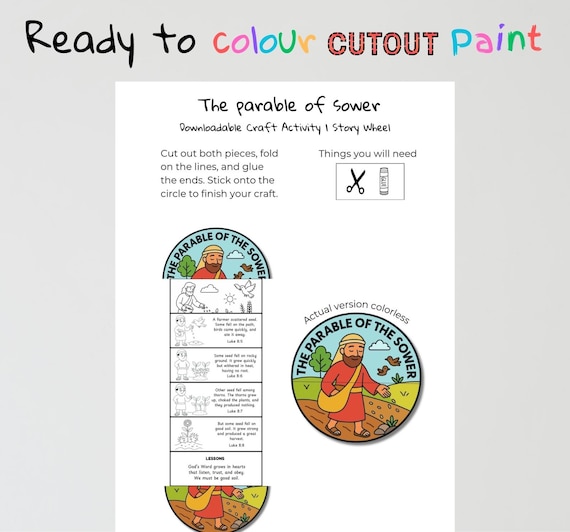
- Divide a page into four boxes and label them road, rock, thorns, and good soil.
- Draw or add simple textures in each box, then place small paper dots or seeds in each section.
- Under each box, write a short phrase from Luke’s explanation such as ‘taken away’, ‘no root’, ‘choked’, or ‘bears fruit’.
- Pair children to explain their chart in order using Luke 8:11-15.
- If appropriate, add one comparison note: Matthew says the roadside hearer ‘doesn’t understand’, while Luke says the devil takes the word away so they may not believe and be saved.
This activity helps children connect the picture story in Luke 8:5-8 with Jesus’ explanation in Luke 8:11-15, while noticing one clear comparison from Matthew.
Adapt for your group
- For younger children, let them act each soil with simple motions: flat hands for the road, a quick sprout then droop for the rock, squeezing hands for thorns, and raised arms for growing fruit.
- For older or confident readers, give them one soil and ask them to compare Luke with either Matthew or Mark, naming one detail each Gospel stresses without blending the wording.
An optional closing prayer
You may pray: ‘Lord Jesus, please help us hear your word, hold on to it, and bear fruit with perseverance. Amen.’
Read the Bible passage World English Bible Classic
Matthew 13
1 On that day Jesus went out of the house and sat by the seaside.
2 Great multitudes gathered to him, so that he entered into a boat and sat; and all the multitude stood on the beach.
3 He spoke to them many things in parables, saying, “Behold, a farmer went out to sow.
4 As he sowed, some seeds fell by the roadside, and the birds came and devoured them.
5 Others fell on rocky ground, where they didn’t have much soil, and immediately they sprang up, because they had no depth of earth.
6 When the sun had risen, they were scorched. Because they had no root, they withered away.
7 Others fell among thorns. The thorns grew up and choked them.
8 Others fell on good soil and yielded fruit: some one hundred times as much, some sixty, and some thirty.
9 He who has ears to hear, let him hear.”
10 The disciples came, and said to him, “Why do you speak to them in parables?”
11 He answered them, “To you it is given to know the mysteries of the Kingdom of Heaven, but it is not given to them.
12 For whoever has, to him will be given, and he will have abundance; but whoever doesn’t have, from him will be taken away even that which he has.
13 Therefore I speak to them in parables, because seeing they don’t see, and hearing, they don’t hear, neither do they understand.
14 In them the prophecy of Isaiah is fulfilled, which says, ‘By hearing you will hear, and will in no way understand; Seeing you will see, and will in no way perceive;
15 for this people’s heart has grown callous, their ears are dull of hearing, and they have closed their eyes; or else perhaps they might perceive with their eyes, hear with their ears, understand with their heart, and would turn again, and I would heal them.’
16 “But blessed are your eyes, for they see; and your ears, for they hear.
17 For most certainly I tell you that many prophets and righteous men desired to see the things which you see, and didn’t see them; and to hear the things which you hear, and didn’t hear them.
18 “Hear, then, the parable of the farmer.
19 When anyone hears the word of the Kingdom and doesn’t understand it, the evil one comes and snatches away that which has been sown in his heart. This is what was sown by the roadside.
20 What was sown on the rocky places, this is he who hears the word and immediately with joy receives it;
21 yet he has no root in himself, but endures for a while. When oppression or persecution arises because of the word, immediately he stumbles.
22 What was sown among the thorns, this is he who hears the word, but the cares of this age and the deceitfulness of riches choke the word, and he becomes unfruitful.
23 What was sown on the good ground, this is he who hears the word and understands it, who most certainly bears fruit and produces, some one hundred times as much, some sixty, and some thirty.”
Mark 4
1 Again he began to teach by the seaside. A great multitude was gathered to him, so that he entered into a boat in the sea and sat down. All the multitude were on the land by the sea.
2 He taught them many things in parables, and told them in his teaching,
3 “Listen! Behold, the farmer went out to sow.
4 As he sowed, some seed fell by the road, and the birds came and devoured it.
5 Others fell on the rocky ground, where it had little soil, and immediately it sprang up, because it had no depth of soil.
6 When the sun had risen, it was scorched; and because it had no root, it withered away.
7 Others fell among the thorns, and the thorns grew up and choked it, and it yielded no fruit.
8 Others fell into the good ground and yielded fruit, growing up and increasing. Some produced thirty times, some sixty times, and some one hundred times as much.”
9 He said, “Whoever has ears to hear, let him hear.”
10 When he was alone, those who were around him with the twelve asked him about the parables.
11 He said to them, “To you is given the mystery of God’s Kingdom, but to those who are outside, all things are done in parables,
12 that ‘seeing they may see and not perceive, and hearing they may hear and not understand, lest perhaps they should turn again, and their sins should be forgiven them.’ ”
13 He said to them, “Don’t you understand this parable? How will you understand all of the parables?
14 The farmer sows the word.
15 The ones by the road are the ones where the word is sown; and when they have heard, immediately Satan comes and takes away the word which has been sown in them.
16 These in the same way are those who are sown on the rocky places, who, when they have heard the word, immediately receive it with joy.
17 They have no root in themselves, but are short-lived. When oppression or persecution arises because of the word, immediately they stumble.
18 Others are those who are sown among the thorns. These are those who have heard the word,
19 and the cares of this age, and the deceitfulness of riches, and the lusts of other things entering in choke the word, and it becomes unfruitful.
20 Those which were sown on the good ground are those who hear the word, accept it, and bear fruit, some thirty times, some sixty times, and some one hundred times.”
Luke 8
4 When a great multitude came together and people from every city were coming to him, he spoke by a parable:
5 “The farmer went out to sow his seed. As he sowed, some fell along the road, and it was trampled under foot, and the birds of the sky devoured it.
6 Some seed fell on the rock, and as soon as it grew, it withered away, because it had no moisture.
7 Some fell amid the thorns, and the thorns grew with it and choked it.
8 Some fell into the good ground and grew and produced one hundred times as much fruit.” As he said these things, he called out, “He who has ears to hear, let him hear!”
9 Then his disciples asked him, “What does this parable mean?”
10 He said, “To you it is given to know the mysteries of God’s Kingdom, but to the rest it is given in parables, that ‘seeing they may not see, and hearing they may not understand.’
11 “Now the parable is this: The seed is the word of God.
12 Those along the road are those who hear; then the devil comes and takes away the word from their heart, that they may not believe and be saved.
13 Those on the rock are they who, when they hear, receive the word with joy; but these have no root. They believe for a while, then fall away in time of temptation.
14 What fell among the thorns, these are those who have heard, and as they go on their way they are choked with cares, riches, and pleasures of life; and they bring no fruit to maturity.
15 Those in the good ground, these are those who with an honest and good heart, having heard the word, hold it tightly, and produce fruit with perseverance.
World English Bible Classic. Public domain.
Source passages
Something to make together
These activities connect with the passage. Choose one that suits your group and the time you have.