Single lesson
The Wise and Foolish Builders
Matthew 7:24–27; Luke 6:46–49
Jesus told a short parable about two builders to show the difference between hearing his words and actually doing them. This lesson helps children notice the warning question in Luke and the clear contrast in both accounts.
Before you teach
In Matthew, Jesus speaks about people who hear his words and either do them or do not do them. In Luke, he first asks why people call him ‘Lord, Lord’ without doing what he says, then explains with the picture of two houses facing water and storm.
Students will be able to explain that in this parable the wise response is to hear Jesus’ words and do them, while the foolish response is to hear them and not do them.
Welcome: Two houses, two choices
4 minShow two quick sketches of a house, or hold up two building surfaces such as a tray of sand and a flat rock. Tell the group that Jesus used a parable, an illustration he told, about building to teach a deeper point. Explain that today they will listen for what makes one builder wise and the other foolish.
Matthew 7:24, Matthew 7:26, Luke 6:47, Luke 6:49
Read and explain: What question starts the parable?
7 minRead the Luke account and the Matthew account aloud. Point out that Luke begins with a searching question: why call Jesus ‘Lord, Lord’ and not do what he says? Then note the repeated pattern in both accounts: hearing Jesus’ words, then either doing them or not doing them. The parable is about response to Jesus’ words.
Luke 6:46, Luke 6:47, Luke 6:49, Matthew 7:24, Matthew 7:26
Discuss: Wise building and foolish building
6 minCompare the builders carefully. In Matthew, one house is on the rock and one on the sand. In Luke, one builder digs deep and lays a foundation on the rock, while the other builds on the earth without a foundation. Ask children what stays the same in both versions: storm or flood comes, and the strong house stands because of its foundation.
Matthew 7:24, Matthew 7:25, Matthew 7:26, Matthew 7:27, Luke 6:48, Luke 6:49
Make and respond: Build to remember
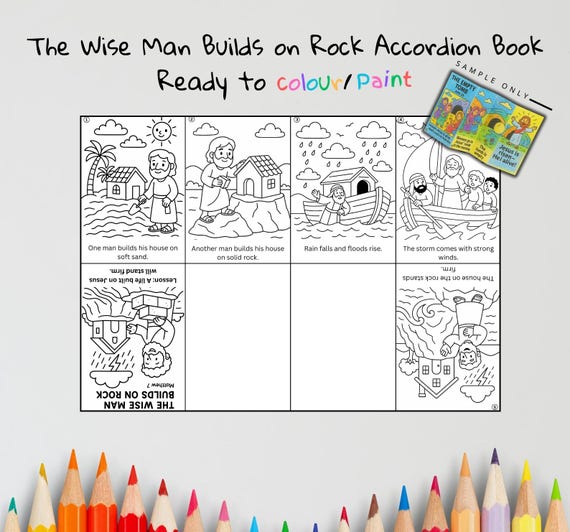
8 minChildren make a simple two-part model showing a house on a firm base and a house on a weak base. As they work, ask them to describe the difference between hearing Jesus’ words and doing them, or hearing and not doing. You can also invite a simple everyday example of listening and then acting, so the focus stays on response to words in the parable.
Matthew 7:24, Matthew 7:26, Luke 6:47, Luke 6:49
Closing: Say the lesson back
5 minInvite pairs to finish this sentence: ‘The wise builder is like...’ and ‘The foolish builder is like...’ Then say together that storms tested both houses, but only the house founded on the rock stood firm. Finish by reminding children that the parable calls listeners not only to hear Jesus, but to do what he says.
Matthew 7:25, Matthew 7:27, Luke 6:48, Luke 6:49
Questions to explore
What question does Jesus ask before telling the building illustration in Luke?
Look at the exact words in Luke and notice that Jesus asks about calling him ‘Lord, Lord’ without doing what he says.
Luke 6:46
What makes the wise builder wise in this parable?
The passage does not praise building skills by themselves. It says the wise person hears Jesus’ words and does them.
Matthew 7:24, Luke 6:47
What happens to each house when the water and storm strike?
Compare the two outcomes carefully. One house does not fall or shake because it is founded on the rock, and the other falls with great ruin.
Matthew 7:25, Matthew 7:27, Luke 6:48, Luke 6:49
Make, think or respond
Rock or Sand House Model
What you’ll need
- small blocks or Lego
- a tray or bowl of sand or loose soil
- a flat stone, board, or book
- toy house or paper squares
Try it together
- Set one building surface on a flat stone, board, or book, and set the other on sand or loose soil.
- Help children build a small house or place a toy house on each surface.
- Gently shake the tray or blow across both scenes to observe which base is firmer.
- Ask children to say which picture matches hearing and doing Jesus’ words, and which matches hearing without doing.
The model gives children a visible reminder that Jesus’ parable compares two responses to his words, not just two building projects.
Adapt for your group
- For younger children, keep one short repeated sentence through the lesson: ‘Wise means hear and do.’ Let them point to the strong house when they hear it.
- For older or more confident children, ask them to compare Matthew and Luke and name one detail Luke adds, such as digging deep or the opening question in Luke 6:46.
An optional closing prayer
You might pray: ‘Lord Jesus, please help us to hear your words and do them. Help us to be wise listeners who obey you. Amen.’
Read the Bible passage World English Bible Classic
Matthew 7
24 “Everyone therefore who hears these words of mine and does them, I will liken him to a wise man who built his house on the rock.
25 The rain came down, the floods came, and the winds blew and beat on that house; and it didn’t fall, for it was founded on the rock.
26 Everyone who hears these words of mine and doesn’t do them will be like a foolish man who built his house on the sand.
27 The rain came down, the floods came, and the winds blew and beat on that house; and it fell—and its fall was great.”
Luke 6
46 “Why do you call me, ‘Lord, Lord,’ and don’t do the things which I say?
47 Everyone who comes to me, and hears my words and does them, I will show you who he is like.
48 He is like a man building a house, who dug and went deep and laid a foundation on the rock. When a flood arose, the stream broke against that house, and could not shake it, because it was founded on the rock.
49 But he who hears and doesn’t do, is like a man who built a house on the earth without a foundation, against which the stream broke, and immediately it fell; and the ruin of that house was great.”
World English Bible Classic. Public domain.
Source passages
Something to make together
These activities connect with the passage. Choose one that suits your group and the time you have.