


Read & explore together
David's Last Words
These last words of David come as a poem, not a story. The passage presents who David is, says that God spoke, paints a picture of righteous rule, expresses covenant hope, and ends with a warning about the ungodly.
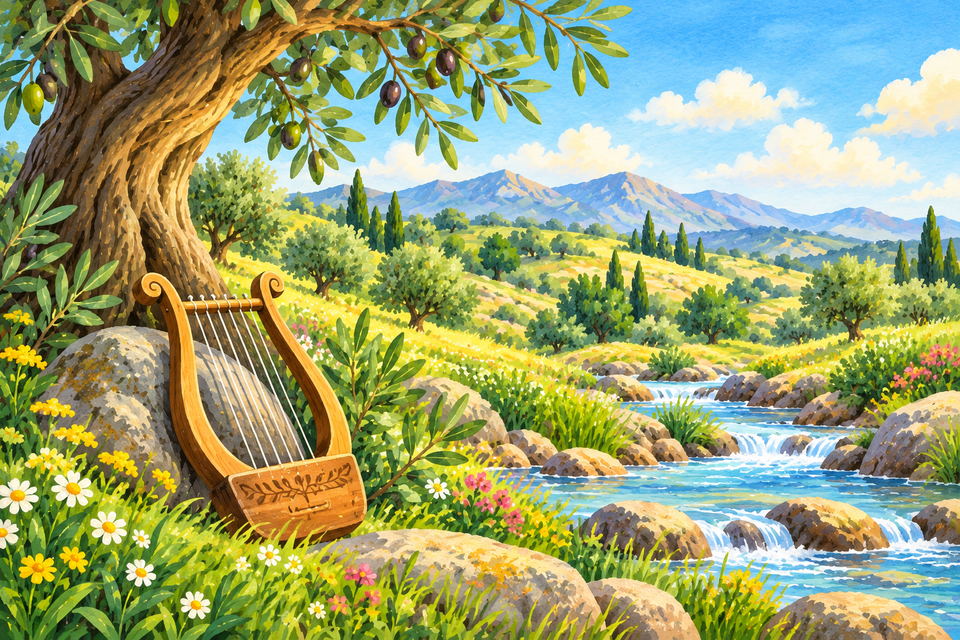
Understanding the passage
Read these words in context
The poem opens by identifying David with several titles found in the verse itself: son of Jesse, raised on high, anointed by the God of Jacob, and sweet psalmist of Israel. From there, the passage moves in order through Yahweh’s speech, a simile of morning light, David’s confidence in God’s covenant, and the removal of the ungodly.
2 Samuel 23:1–7Main takeaway
This poem teaches that God speaks about righteous rule in the fear of God, gives David confidence in a sure covenant, and warns that the ungodly will not remain.
Explore the poem and its images
Open a card to explore the full explanation and its Bible references.
01David’s last words are introducedThe passage begins by calling these David’s last words. It names him as the son of Jesse, the man raised on high, the anointed of the God of Jacob, and the sweet psalmist of Israel.
Explanation
The passage begins by calling these David’s last words. It names him as the son of Jesse, the man raised on high, the anointed of the God of Jacob, and the sweet psalmist of Israel. These descriptions prepare us to hear a solemn poem spoken by David at the end.
02David says God spoke through himDavid says Yahweh’s Spirit spoke by him and that God’s word was on his tongue. Then the God of Israel, also called the Rock of Israel, speaks.
Explanation
David says Yahweh’s Spirit spoke by him and that God’s word was on his tongue. Then the God of Israel, also called the Rock of Israel, speaks. The message is about one who rules over people righteously and rules in the fear of God.
03Righteous rule is like a bright, fruitful morningThe poem compares such rule to sunrise light, a morning without clouds, and tender grass springing up after rain and clear shining.
Explanation
The poem compares such rule to sunrise light, a morning without clouds, and tender grass springing up after rain and clear shining. These are poetic images, showing beauty, clarity, and growth. The passage does not give a list of policies, but a picture of goodness under God.
04David trusts God’s covenant, while the ungodly are removedDavid says God has made with him an everlasting covenant, ordered in all things and sure. He calls it all his salvation and desire, and asks whether God will not make it grow.
Explanation
David says God has made with him an everlasting covenant, ordered in all things and sure. He calls it all his salvation and desire, and asks whether God will not make it grow. In contrast, the ungodly are like thorns, unsafe to handle and destined to be thrust away and burned.
Questions to explore
Pause, look back at the verses and talk together.
01Which names and titles are given to David at the start of the poem?
Read the opening verse slowly and list each description exactly as it appears.
02What does David say about the source of his words?
Notice the statements about Yahweh’s Spirit and God’s word before the poem describes righteous rule.
03How does the poem contrast covenant hope with the fate of the ungodly?
Compare the words everlasting, sure, salvation, and desire with the images of thorns, weapons, and burning.
Read the Bible passage
World English Bible ClassicScripture quotation · Public domain
2 Samuel 23:1–7
1Now these are the last words of David. David the son of Jesse says, the man who was raised on high says, the anointed of the God of Jacob, the sweet psalmist of Israel:
2“Yahweh’s Spirit spoke by me. His word was on my tongue.
3The God of Israel said, the Rock of Israel spoke to me, ‘One who rules over men righteously, who rules in the fear of God,
4shall be as the light of the morning when the sun rises, a morning without clouds, when the tender grass springs out of the earth, through clear shining after rain.’
5Isn’t my house so with God? Yet he has made with me an everlasting covenant, ordered in all things, and sure, for it is all my salvation and all my desire. Won’t he make it grow?
6But all the ungodly will be as thorns to be thrust away, because they can’t be taken with the hand.
7The man who touches them must be armed with iron and the staff of a spear. They will be utterly burned with fire in their place.”