Single lesson
Jesus Walks with Two Disciples to Emmaus
Mark 16:12–13; Luke 24:13–35
This lesson helps children follow the road to Emmaus story in order. They will notice what the two disciples said, what Jesus explained, how they recognised him, and how their response changed after they knew it was Jesus.
Before you teach
Mark says Jesus was revealed to two followers as they walked into the country, and that others did not believe their report. Luke gives the fuller account: two disciples walked to Emmaus, spoke about recent events, met Jesus without recognising him, heard the Scriptures explained, recognised him at the table, and returned to Jerusalem to tell others.
Students will be able to sequence Luke 24:13–35, name key choices and outcomes in the passage, and explain that Jesus opened the Scriptures and was recognised by the two disciples.
Welcome: What changed on the road?
4 minAsk children to listen for three turning points in the story: when Jesus came near, when the disciples urged him to stay, and when they recognised him. Explain that Mark briefly mentions the event, while Luke tells what happened in detail. Tell the class they will track the order carefully and see how the disciples’ response changed.
Mark 16:12, Mark 16:13, Luke 24:15, Luke 24:29, Luke 24:31
Read and explain: From sadness to understanding
8 minRead Luke 24:13–27 aloud. Point out that the two disciples were talking about what had happened and were sad. Jesus joined them, but they did not recognise him. Cleopas described Jesus as a prophet mighty in deed and word, told about his crucifixion, and repeated the report from the women and the tomb. Then Jesus said they were slow to believe what the prophets had spoken and explained the Scriptures concerning himself.
Luke 24:14, Luke 24:15, Luke 24:16, Luke 24:17, Luke 24:19, Luke 24:20, Luke 24:22, Luke 24:23, Luke 24:25, Luke 24:27
Discuss: Choices and outcomes in the village
6 minRead Luke 24:28–32. Help children notice one important choice: the disciples urged Jesus to stay with them. At the table, Jesus took bread, gave thanks, broke it, and gave it to them. Then their eyes were opened and they recognised him. Afterwards they spoke about what had happened on the road and how he had opened the Scriptures to them.
Luke 24:28, Luke 24:29, Luke 24:30, Luke 24:31, Luke 24:32
Make and respond: Emmaus sequence cards
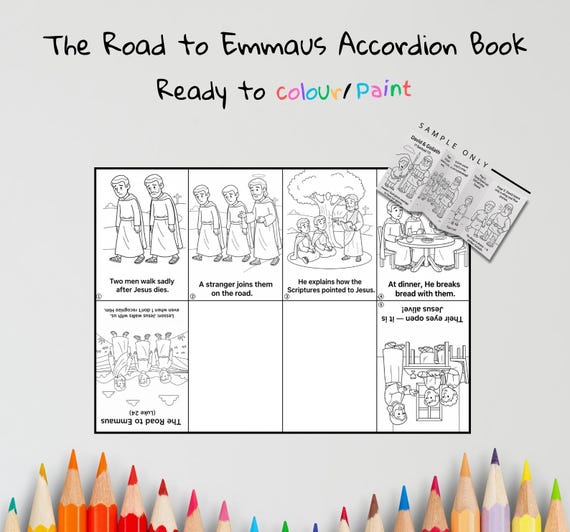
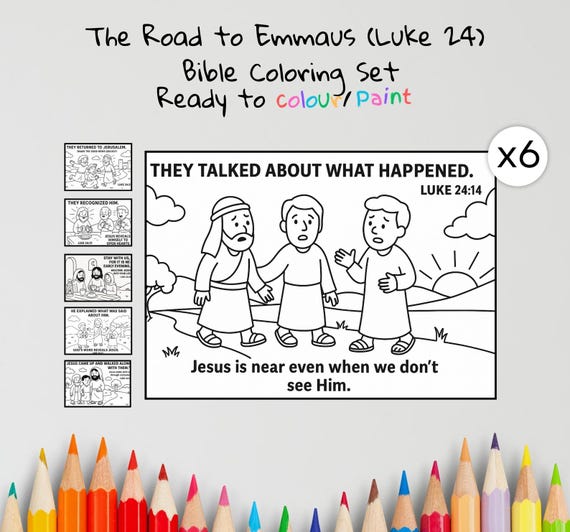
8 minChildren make six simple sequence cards for the account: walking to Emmaus, Jesus joins them, Jesus explains the Scriptures, they ask him to stay, they recognise him in the breaking of bread, they return to Jerusalem and tell others. After arranging the cards, ask each child to explain one choice or outcome from the order they made.
Luke 24:13, Luke 24:15, Luke 24:27, Luke 24:29, Luke 24:31, Luke 24:33, Luke 24:35
Closing: Tell what they told
4 minFinish by reading Luke 24:33–35 and Mark 16:13. Emphasise that the two disciples did not keep the news to themselves. They returned that very hour, found the gathered group, and related what happened along the way and how Jesus was recognised by them. Invite children to say the story in three sentences from sadness, to understanding, to telling.
Luke 24:33, Luke 24:35, Mark 16:13
Questions to explore
What were the two disciples talking about before Jesus came near them?
Look at how Luke describes their conversation and sadness, and then how Cleopas explains the events concerning Jesus.
Luke 24:14, Luke 24:17, Luke 24:19, Luke 24:20, Luke 24:21
What happened after the disciples urged Jesus to stay with them?
Trace the order from their invitation, to the meal, to the moment their eyes were opened.
Luke 24:28, Luke 24:29, Luke 24:30, Luke 24:31
How did the two disciples respond once they recognised Jesus?
Notice what they did that very hour and what they reported to the others.
Luke 24:33, Luke 24:35, Mark 16:13
Make, think or respond
Emmaus Story Sequence Cards
What you’ll need
- plain paper or card
- pencils or crayons
- scissors
- Bible
Try it together
- Help children identify six main moments from Luke 24:13–35.
- Children draw one moment on each card and add a short label.
- Mix the cards and have children place them back in order using the Bible reading.
- Ask each child to point to one card and tell the choice made or the outcome that followed.
- If time allows, children retell the whole account using the ordered cards.
This activity helps children sequence the passage and see how the disciples moved from talking in sadness to recognising Jesus and telling others.
Adapt for your group
- For younger children, prepare the six event labels orally and let them draw only four key scenes instead of six.
- For older or more confident children, ask them to include a matching verse reference on each card and explain why Luke 24:32 matters in the story.
An optional closing prayer
You may pray: “Lord Jesus, thank you for this true account. Please help us listen carefully to your word, understand what we read, and respond truthfully like these disciples did.”
Read the Bible passage World English Bible Classic
Mark 16
12 After these things he was revealed in another form to two of them as they walked, on their way into the country.
13 They went away and told it to the rest. They didn’t believe them, either.
Luke 24
13 Behold, two of them were going that very day to a village named Emmaus, which was sixty stadia from Jerusalem.
14 They talked with each other about all of these things which had happened.
15 While they talked and questioned together, Jesus himself came near, and went with them.
16 But their eyes were kept from recognizing him.
17 He said to them, “What are you talking about as you walk, and are sad?”
18 One of them, named Cleopas, answered him, “Are you the only stranger in Jerusalem who doesn’t know the things which have happened there in these days?”
19 He said to them, “What things?” They said to him, “The things concerning Jesus the Nazarene, who was a prophet mighty in deed and word before God and all the people;
20 and how the chief priests and our rulers delivered him up to be condemned to death, and crucified him.
21 But we were hoping that it was he who would redeem Israel. Yes, and besides all this, it is now the third day since these things happened.
22 Also, certain women of our company amazed us, having arrived early at the tomb;
23 and when they didn’t find his body, they came saying that they had also seen a vision of angels, who said that he was alive.
24 Some of us went to the tomb and found it just like the women had said, but they didn’t see him.”
25 He said to them, “Foolish people, and slow of heart to believe in all that the prophets have spoken!
26 Didn’t the Christ have to suffer these things and to enter into his glory?”
27 Beginning from Moses and from all the prophets, he explained to them in all the Scriptures the things concerning himself.
28 They came near to the village where they were going, and he acted like he would go further.
29 They urged him, saying, “Stay with us, for it is almost evening, and the day is almost over.” He went in to stay with them.
30 When he had sat down at the table with them, he took the bread and gave thanks. Breaking it, he gave it to them.
31 Their eyes were opened and they recognized him; then he vanished out of their sight.
32 They said to one another, “Weren’t our hearts burning within us while he spoke to us along the way, and while he opened the Scriptures to us?”
33 They rose up that very hour, returned to Jerusalem, and found the eleven gathered together, and those who were with them,
34 saying, “The Lord is risen indeed, and has appeared to Simon!”
35 They related the things that happened along the way, and how he was recognized by them in the breaking of the bread.
World English Bible Classic. Public domain.
Source passages
Something to make together
These activities connect with the passage. Choose one that suits your group and the time you have.