Single lesson
Joseph Is Sold into Egypt
Genesis 37:12–36
In this lesson, students work through Genesis 37:12–36 in order, tracing Joseph’s journey to his brothers, their violent choices, the deception of their father, and Joseph’s arrival in Egypt.
Before you teach
Israel sends Joseph to check on his brothers and the flock. Joseph searches until he finds them in Dothan. The passage then records a plot against him, Reuben’s attempt to spare his life, Judah’s proposal to sell him, the false report built around the tunic, Jacob’s mourning, and Joseph’s sale in Egypt.
Students will be able to sequence Genesis 37:12–36, identify major choices and outcomes in the passage, and describe what these verses show about harmful human actions, deceit, and grief.
Welcome: Track Joseph’s mission
6 minOpen by reading Genesis 37:12–17 aloud. Ask students to listen for Joseph’s task, the places named, and the effort Joseph makes to complete what Israel asks. Note that Joseph is sent to check whether it is well with his brothers and the flock, then keeps searching until he finds them in Dothan.
Genesis 37:12, Genesis 37:13, Genesis 37:14, Genesis 37:15, Genesis 37:16, Genesis 37:17
Read and explain: The plot and the pit
10 minRead Genesis 37:18–24 carefully and soberly. Explain that the brothers conspire to kill Joseph and plan to cover it with a false story. Reuben opposes taking Joseph’s life and tells them to throw him into a pit instead, with the text stating that he intended to restore Joseph to his father. They strip Joseph’s tunic and throw him into an empty pit.
Genesis 37:18, Genesis 37:19, Genesis 37:20, Genesis 37:21, Genesis 37:22, Genesis 37:23, Genesis 37:24
Discuss: A changed plan still harms Joseph
8 minRead Genesis 37:25–28. Students identify how the plan changes from murder to sale. Judah argues that killing Joseph brings no profit and says Joseph is their brother, their flesh, yet still proposes selling him to the Ishmaelites. The result remains severe: Joseph is lifted from the pit, sold for twenty pieces of silver, and taken to Egypt.
Genesis 37:25, Genesis 37:26, Genesis 37:27, Genesis 37:28
Make and respond: Sequence and consequence cards
10 minStudents make eight cards showing exact moments from the passage, then place them in order and label each with a verse reference. After sequencing, ask them to mark each card with either a choice or an outcome. This keeps the focus on what the text states and helps students see how one action leads to another.
Genesis 37:13, Genesis 37:17, Genesis 37:18, Genesis 37:24, Genesis 37:27, Genesis 37:28, Genesis 37:31, Genesis 37:36
Closing: Deception, grief, and Joseph in Egypt
6 minFinish by reading Genesis 37:29–36. Reuben returns and is distressed that Joseph is gone. The brothers use Joseph’s tunic to deceive their father, and Jacob mourns many days and refuses comfort. Close by asking students to summarise one choice and one outcome from the passage, including Joseph’s sale to Potiphar in Egypt.
Genesis 37:29, Genesis 37:30, Genesis 37:31, Genesis 37:32, Genesis 37:33, Genesis 37:34, Genesis 37:35, Genesis 37:36
Questions to explore
What details show that Joseph faithfully carried out the task Israel gave him?
Look for the instructions Israel gives, Joseph’s wandering in the field, his question to the man, and his decision to go on to Dothan.
Genesis 37:13, Genesis 37:14, Genesis 37:15, Genesis 37:16, Genesis 37:17
How does the plan for Joseph change across the passage, and which outcomes remain harmful?
Compare the brothers’ first plan to kill Joseph, Reuben’s intervention, Judah’s proposal to sell him, and the final result that Joseph is sold and taken to Egypt.
Genesis 37:20, Genesis 37:21, Genesis 37:22, Genesis 37:27, Genesis 37:28, Genesis 37:36
How do the brothers deceive their father, and what effect does the passage describe on Jacob?
Trace the tunic being dipped in blood, brought to Jacob, recognised by him, and followed by his mourning and refusal to be comforted.
Genesis 37:31, Genesis 37:32, Genesis 37:33, Genesis 37:34, Genesis 37:35
Make, think or respond
Choice and Outcome Sequence Cards
What you’ll need
- plain paper or card
- pens or textas
- scissors
- Bible
- small envelopes or paper clips
Try it together
- Write or draw eight key moments from Genesis 37:12–36 on separate cards.
- Read the passage again and arrange the cards in the correct order.
- Add the exact verse reference to each card and mark each one as either a choice or an outcome.
- Pair up and use the cards to retell the passage accurately, keeping to what the verses say.
This activity helps students follow the sequence of Genesis 37:12–36 and notice how the passage connects people’s choices with the outcomes that follow.
Adapt for your group
- For younger teens, provide the eight event titles first and ask them to match each title to the correct verse before ordering the cards.
- For older or more confident students, ask them to add the names Reuben, Judah, Ishmaelites, Midianites, Jacob, and Potiphar to the relevant cards and explain each person’s part from the text.
An optional closing prayer
“God, help us read this passage honestly, recognise harmful choices, value truth, and respond with wisdom and care toward others. Amen.”
Read the Bible passage World English Bible Classic
Genesis 37
12 His brothers went to feed their father’s flock in Shechem.
13 Israel said to Joseph, “Aren’t your brothers feeding the flock in Shechem? Come, and I will send you to them.” He said to him, “Here I am.”
14 He said to him, “Go now, see whether it is well with your brothers, and well with the flock; and bring me word again.” So he sent him out of the valley of Hebron, and he came to Shechem.
15 A certain man found him, and behold, he was wandering in the field. The man asked him, “What are you looking for?”
16 He said, “I am looking for my brothers. Tell me, please, where they are feeding the flock.”
17 The man said, “They have left here, for I heard them say, ‘Let’s go to Dothan.’ ” Joseph went after his brothers, and found them in Dothan.
18 They saw him afar off, and before he came near to them, they conspired against him to kill him.
19 They said to one another, “Behold, this dreamer comes.
20 Come now therefore, and let’s kill him, and cast him into one of the pits, and we will say, ‘An evil animal has devoured him.’ We will see what will become of his dreams.”
21 Reuben heard it, and delivered him out of their hand, and said, “Let’s not take his life.”
22 Reuben said to them, “Shed no blood. Throw him into this pit that is in the wilderness, but lay no hand on him”—that he might deliver him out of their hand, to restore him to his father.
23 When Joseph came to his brothers, they stripped Joseph of his tunic, the tunic of many colors that was on him;
24 and they took him, and threw him into the pit. The pit was empty. There was no water in it.
25 They sat down to eat bread, and they lifted up their eyes and looked, and saw a caravan of Ishmaelites coming from Gilead, with their camels bearing spices and balm and myrrh, going to carry it down to Egypt.
26 Judah said to his brothers, “What profit is it if we kill our brother and conceal his blood?
27 Come, and let’s sell him to the Ishmaelites, and not let our hand be on him; for he is our brother, our flesh.” His brothers listened to him.
28 Midianites who were merchants passed by, and they drew and lifted up Joseph out of the pit, and sold Joseph to the Ishmaelites for twenty pieces of silver. The merchants brought Joseph into Egypt.
29 Reuben returned to the pit, and saw that Joseph wasn’t in the pit; and he tore his clothes.
30 He returned to his brothers, and said, “The child is no more; and I, where will I go?”
31 They took Joseph’s tunic, and killed a male goat, and dipped the tunic in the blood.
32 They took the tunic of many colors, and they brought it to their father, and said, “We have found this. Examine it, now, and see if it is your son’s tunic or not.”
33 He recognized it, and said, “It is my son’s tunic. An evil animal has devoured him. Joseph is without doubt torn in pieces.”
34 Jacob tore his clothes, and put sackcloth on his waist, and mourned for his son many days.
35 All his sons and all his daughters rose up to comfort him, but he refused to be comforted. He said, “For I will go down to Sheol to my son, mourning.” His father wept for him.
36 The Midianites sold him into Egypt to Potiphar, an officer of Pharaoh’s, the captain of the guard.
World English Bible Classic. Public domain.
Source passages
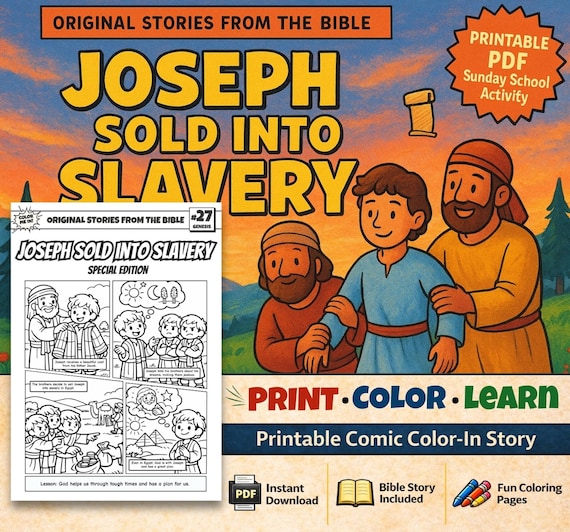
Something to make together
These activities connect with the passage. Choose one that suits your group and the time you have.